
An AI model can be technically impressive in a test environment, but bringing AI into production requires a robust infrastructure capable of supporting data, compute, storage, networking, APIs, deployment, scaling, monitoring, and security.
AI capability depends not only on the model itself, but also on the infrastructure that runs it. While MLOps helps operationalize machine learning workflows, cloud infrastructure provides the underlying environment in which those systems run at scale.
What Is Cloud Infrastructure for AI?
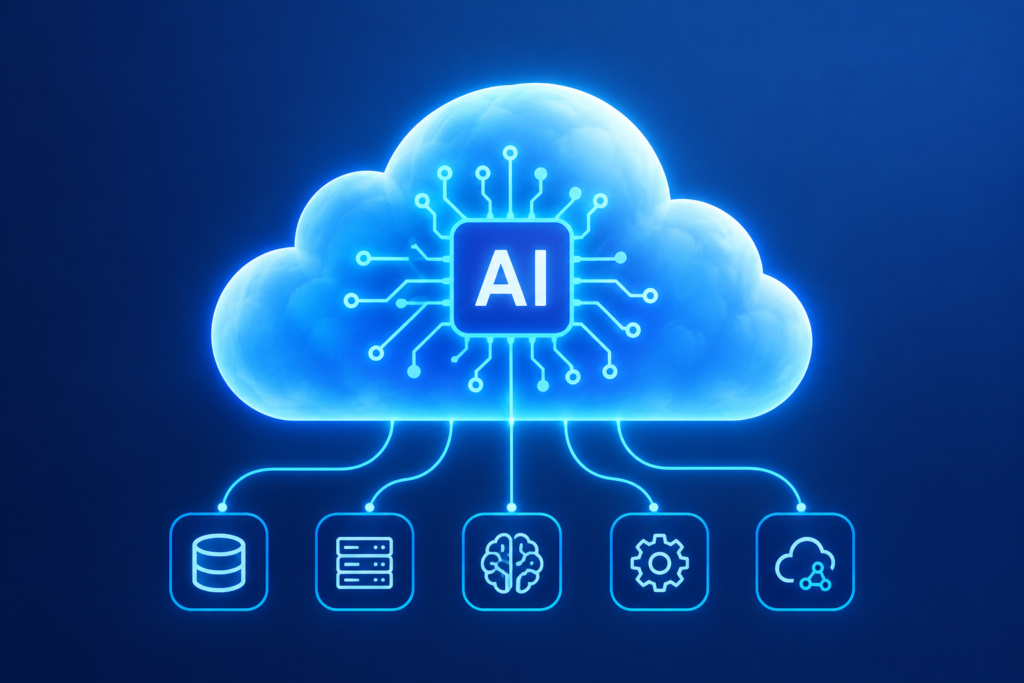
Cloud infrastructure for AI refers to the computing, storage, networking, data management, and supporting services used to build, train, deploy, and operate AI systems in cloud environments.
Unlike traditional cloud applications, which typically rely on application servers, CPUs, databases, and storage, AI workloads require infrastructure designed to support data-intensive processing and model execution. A traditional cloud workload generally follows a flow from the application to compute resources, databases, and storage. An AI workload, however, involves a broader lifecycle in which data flows through compute resources—often including GPUs—to train or run a model, which is then integrated into an application or API and continuously monitored.
These differences introduce specific infrastructure requirements, including parallel processing for compute-intensive workloads, high-throughput data pipelines, low-latency model inference, and effective cost management as resource demands change. Selecting the right cloud architecture helps organizations support AI workloads efficiently while maintaining performance, scalability, and reliability.
Why Are Organizations Using the Cloud for AI?
- Access to Scalable Compute: Organizations can dynamically provision additional resources as training datasets or usage volumes grow.
- Access to GPUs and Specialized Hardware: AI training and high-throughput inference require specialized accelerators (such as GPUs and TPUs) that are costly to maintain on-premises.
- Flexible Infrastructure: Teams can experiment with various cluster configurations, model frameworks, and hardware options without upfront hardware acquisition.
- Faster Deployment: Integrated cloud managed services help teams bridge the gap between development prototypes and production applications faster.
- Global Availability: Cloud networks enable low-latency API serving to end-users distributed across multiple geographic regions.
- Pay-As-You-Go Economics: Infrastructure spending aligns closely with usage—though cost management strategies are required to prevent budget overruns.
What Infrastructure Does AI Actually Need?
Building an AI infrastructure stack requires coordination across several layers:
Compute
- CPUs vs. GPUs vs. AI Accelerators: CPUs manage general orchestration, while GPUs and specialized accelerators (TPUs/NPUs) handle massively parallel matrix math.
- Training vs. Inference: Heavy distributed training clusters require high-bandwidth hardware interconnects, whereas inference infrastructure prioritizes memory efficiency and low-latency response times.
Storage
AI systems need dedicated, tiered storage solutions for:
- Large training datasets and data lakes
- Model weights and artifact repositories
- Vector embeddings and indices
- Operational logs and evaluation telemetry
- End-user and application state data
Networking
Networking is critical for high-throughput data ingestion, fast inter-node communication during distributed training, rapid API routing, model serving, and seamless application integration.
Databases and Data Platforms
A strong data foundation feeds AI applications. Depending on the workload, teams utilize:
- Relational Databases for structured transactional data
- Data Warehouses & Data Lakes for enterprise analytical data and training inputs
- Vector Databases for fast similarity searches and retrieval-augmented generation (RAG)
Containers and Orchestration
Tools like Docker containerize AI models and dependencies, while Kubernetes orchestrates microservices, auto-scaling, and cluster management—ensuring workloads remain portable and reproducible across environments.
Training vs. Inference: Different Cloud Requirements
The infrastructure required to train an AI model is fundamental to its ability to serve predictions reliably:
| Requirement | Training Infrastructure | Inference Infrastructure |
| Primary Focus | Heavy raw compute & bandwidth | Low latency & high availability |
| Resource Type | Multi-GPU / TPU clusters | Optimized GPUs, inferencing chips, or CPUs |
| Data Flow | Large batch processing | Real-time streams or API requests |
| Storage Need | High-throughput data ingestion | Fast access to model weights and vector stores |
| Scaling Goal | Job completion speed | Cost per prediction & traffic auto-scaling |
Cloud Infrastructure for Generative AI
Modern Generative AI architectures expand on traditional ML infrastructure requirements:
- Model Access: Choosing between hosted foundation model APIs (e.g., Bedrock, OpenAI) or self-hosting open-weights models (e.g., Llama).
- GPU Compute: Provisioning dedicated multi-GPU nodes for fine-tuning or running high-throughput custom inference engines.
- Vector Databases: Indexing unstructured knowledge bases for Retrieval-Augmented Generation (RAG) pipelines.
- Model Serving: Implementing serving frameworks (vLLM, TensorRT-LLM) to expose models efficiently via web APIs.
- Scaling: Managing unpredictable peak demand spikes in interactive chat or agentic workflows.
- Observability: Tracking token usage, latency metrics, prompt/response logs, and execution costs.
AWS vs. Azure vs. Google Cloud for AI
Major cloud providers offer capabilities across compute, storage, data platforms, ML platforms, AI APIs, Kubernetes, security, and observability:
| Capability | AWS | Azure | Google Cloud |
| Cloud Compute | ✅ | ✅ | ✅ |
| GPU Infrastructure | ✅ | ✅ | ✅ |
| ML Platforms | ✅ | ✅ | ✅ |
| Data Services | ✅ | ✅ | ✅ |
| Kubernetes | ✅ | ✅ | ✅ |
| AI/ML Services | ✅ | ✅ | ✅ |
There is no single “best” cloud for AI. The ideal selection depends on existing tech stacks, team skill sets, data locality, cost structures, and compliance requirements.
Cloud, MLOps, and AI Engineering: How They Work Together
Building production-ready AI systems requires collaboration across several engineering disciplines. AI Engineering focuses on developing the core AI application logic and integrating models into business applications and workflows. Data Engineering establishes the data foundation by building reliable data pipelines that collect, transform, and deliver the information AI systems need.
Cloud Engineering provides the underlying infrastructure, including scalable compute, storage, networking, and cloud resources needed to run AI applications reliably. MLOps streamlines the machine learning lifecycle by automating model training, validation, deployment, monitoring, and ongoing management. Working alongside it, DevOps improves software delivery and operational reliability through CI/CD pipelines, infrastructure as code, and automated deployment processes.
For applications powered by large language models (LLMs), LLMOps adds specialized practices for managing prompts, evaluating model outputs, implementing guardrails, monitoring performance, and controlling token usage and costs. Together, these disciplines create the technical foundation needed to develop, deploy, secure, and maintain AI applications at scale.
Building Cloud and AI Capabilities With WeCloudData
Building and deploying production-ready AI requires more than choosing the right cloud platform or model. It takes a strong technical foundation, sound engineering practices, and people with the skills to build, deploy, secure, scale, and maintain AI systems in real-world environments.
WeCloudData helps individuals and organizations develop these capabilities across the modern technology ecosystem.
- Technical Skill Development: Build practical expertise across Cloud Engineering, AI Engineering, Data Engineering, Data Science, MLOps, and DevOps.
- Career Growth and Specialization: Help professionals expand their technical expertise and prepare for evolving roles at the intersection of cloud, data, and AI.
- Corporate Training and Enterprise Upskilling: Equip teams with targeted, practical training aligned with their existing infrastructure, technical requirements, and AI adoption goals.
Cloud platforms provide the compute, storage, networking, data services, and deployment infrastructure that modern AI applications depend on. Turning these resources into reliable, scalable solutions, however, requires the right architecture, engineering expertise, and operational practices.
Whether you’re an individual strengthening your technical skills or an organization preparing teams to implement AI at scale, WeCloudData helps bridge the gap between technology knowledge and practical capability by supporting the people and engineering foundations needed to bring cloud and AI initiatives into production.
Frequently Asked Questions
1. What is cloud infrastructure for AI?
Cloud infrastructure for AI consists of the compute, storage, networking, database, and orchestration tools hosted in cloud environments to build, deploy, and scale AI models and applications.
2. Why is cloud computing important for AI?
It provides flexible, on-demand access to high-performance hardware like GPUs and scalable data storage without requiring heavy upfront capital investments in physical hardware.
3. What cloud infrastructure does AI need?
AI requires high-performance compute (GPUs/TPUs), high-throughput storage, fast networking, specialized databases (like vector databases), and container orchestration platforms (like Kubernetes).
4. Can AI models run in the cloud?
Yes, most modern AI applications run in the cloud via hosted APIs, containerized endpoints, or managed machine learning platforms.
5. Is AWS, Azure, or Google Cloud best for AI?
All three major cloud providers offer strong AI ecosystems. The best choice depends on your organization’s existing cloud environment, specific technical requirements, and team skill sets.
6. How much does cloud infrastructure for AI cost?
Costs vary widely based on hardware type (CPUs vs. GPUs), data usage, and uptime. Effective cost management requires autoscaling, proper resource sizing, and continuous monitoring.
