
Key Takeaways
- LinkedIn Learning and an LMS solve different problems. LinkedIn Learning provides content, while an LMS manages learning programmes, assignments, tracking, and reporting.
- Content alone isn’t enough as organisations grow. Scaling learning requires structure, automation, and visibility across teams.
- An LMS enables role-based learning. It helps deliver tailored onboarding, compliance, and development pathways for different functions.
- Many organisations benefit from using both. LinkedIn Learning can provide quality content, while an LMS manages the overall learning experience.
- WeCloudData LMS helps growing organisations scale learning with curated content, role-based pathways, and enterprise-wide learning management.
Where upskilling programs might fall short?
The scenario is playing out across hundreds of mid-sized companies this week. Your organization crosses the 150-employee threshold. Executive leadership announces a strategic imperative to upskill the workforce. HR or L&D responds by procuring a bulk license of LinkedIn Learning seats, sending out an enterprise-wide onboarding email, and waiting for organizational transformation to follow.
Fast-forward six months:
- Seat utilization drops precipitously, with off-the-shelf course libraries frequently seeing completion rates as low as 20%.
- Department heads have zero visibility into whether their teams are building actual, job-relevant capabilities.
- Mandatory compliance training, proprietary SOPs, and role-specific onboarding remain trapped in scattered Google Drive folders and endless email threads.
When pressed on why the initiative stalled, leadership often blames employee engagement. But the root cause isn’t workforce apathy. It’s an architectural mistake.
Most growing companies confuse a content library with learning infrastructure. In fact, research by global HR analyst Josh Bersin reveals that despite organizations spending over $400 billion globally on corporate learning, 74% of companies state they are still failing to keep up with their required business skills due to fragmented, non-systemic approaches. Expecting a content subscription to solve an administrative, structural capability challenge is like buying a library card for every employee and assuming it replaces a corporate university.
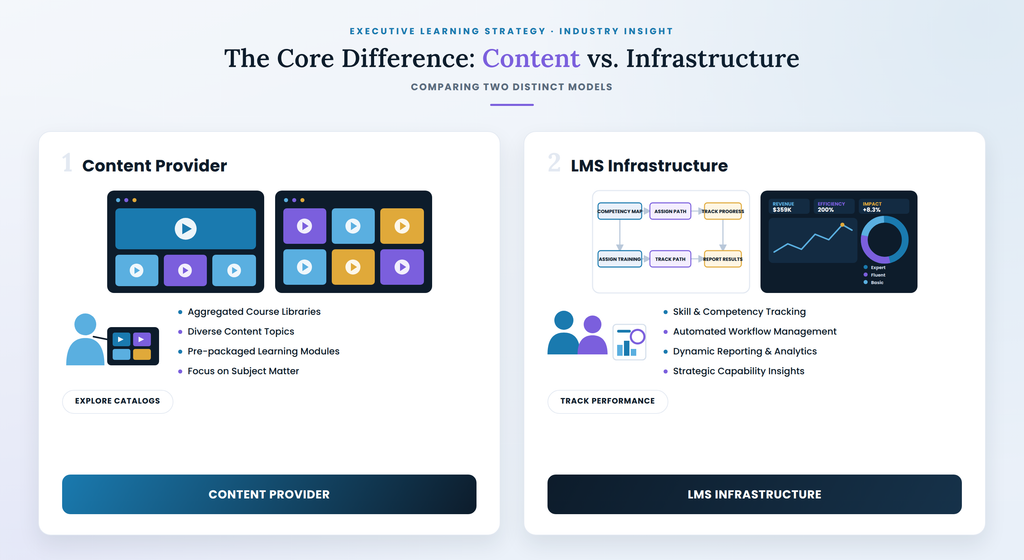
The Core Difference: Content vs. Infrastructure
To build an effective talent development strategy, you must clearly distinguish between the tool that holds knowledge and the software that manages capability.
LinkedIn Learning (The Content Provider)
LinkedIn Learning is a digital repository housing over 20,000 expert-led video courses. It is built for individual, self-directed exploration. It answers the question: “Where can an employee find a quick tutorial on a general topic?”
Learning Management System / LMS (The Infrastructure)
An LMS is an enterprise software platform designed to build, assign, automate, enforce, and track structured learning programs across an entire business. It answers the question: “How does our organization systematically build, verify, and scale the specific capabilities required to execute our strategy?”
LinkedIn Learning is a public library, it offers thousands of books, but no enforced syllabus, degree track, or graduation requirements. An LMS is the administration system, it manages enrollment, enforces prerequisites, tracks credits, and verifies course completion.
What LinkedIn Learning Does Well (& Where It Hits a Wall)
LinkedIn Learning is an exceptional tool when used for its intended purpose. Understanding its natural boundaries prevents costly strategic missteps.
Where LinkedIn Learning Excels
- Vast, On-Demand Catalog: It gives your workforce immediate access to high-production videos covering broad business, creative, and technical subjects without requiring internal content creation.
- Self-Directed Professional Development: It serves intrinsically motivated employees who want to explore adjacent professional skills at their own pace.
- Low Friction Deployment: Provisioning access takes minutes—there is no complex software configuration or data mapping required to launch basic user seats.
Where It Fails Growing Companies
- Zero Custom Internal Processes: You cannot host your company’s proprietary codebase guides, brand-specific workflows, or security compliance policies inside a basic LinkedIn Learning subscription.
- Shallow Analytics: The platform reports on consumption metrics (logins, videos watched, courses completed), but cannot measure hands-on execution, practical assignment output, or actual business impact.
- No Enforced Learning Paths: Because consumption is voluntary, engagement drops sharply after the initial launch high. Without structural accountability, passive watching rarely translates into changed workplace behavior.
What an LMS Does Well (And Where Companies Misjudge It)
An enterprise LMS serves as the central command center for organizational capability.
Where an LMS Excels
- Custom Content & Proprietary Training: An LMS allows you to centralize your company’s unique intellectual property from standard operating procedures to internal AI governance frameworks.
- Role-Based Automation: You can map automated learning pathways based on department, job title, or tenure. When a new Senior Financial Analyst joins, the LMS automatically assigns their specific 30-day onboarding sequence.
- Granular Tracking & Compliance: An LMS provides rigorous oversight, tracking interactive quiz scores, practical assignment submissions, certification expiration dates, and department-level skill gaps.
An LMS is fundamentally a management engine. If you deploy an LMS without structured, high-quality learning content to populate it, you have simply bought an expensive, empty warehouse.
Direct Comparison: Content Library vs. Enterprise LMS
| Capability / Feature | LinkedIn Learning (Content Provider) | Enterprise LMS (Learning Infrastructure) |
| Primary Focus | Off-the-shelf video library | Managing, automating, & enforcing learning systems |
| Proprietary Content Hosting | None (Third-party catalog only) | Full support for internal SOPs, documentation, & media |
| Onboarding Automation | Manual course sharing links | Automated role-based learning assignments |
| Skill & Quiz Verification | Basic watch-time & certificate downloads | Detailed quiz scores, practical assignments, & skill audits |
| Compliance Management | No compliance enforcement mechanisms | Automated recertification schedules, audit logs, & reminders |
| Average Completion Rate | ~20% (Unstructured consumption) | ~80% (Structured mandatory pathways) |
| Primary Learner Mode | Self-directed / Voluntary discovery | Structured / Role-bound execution |
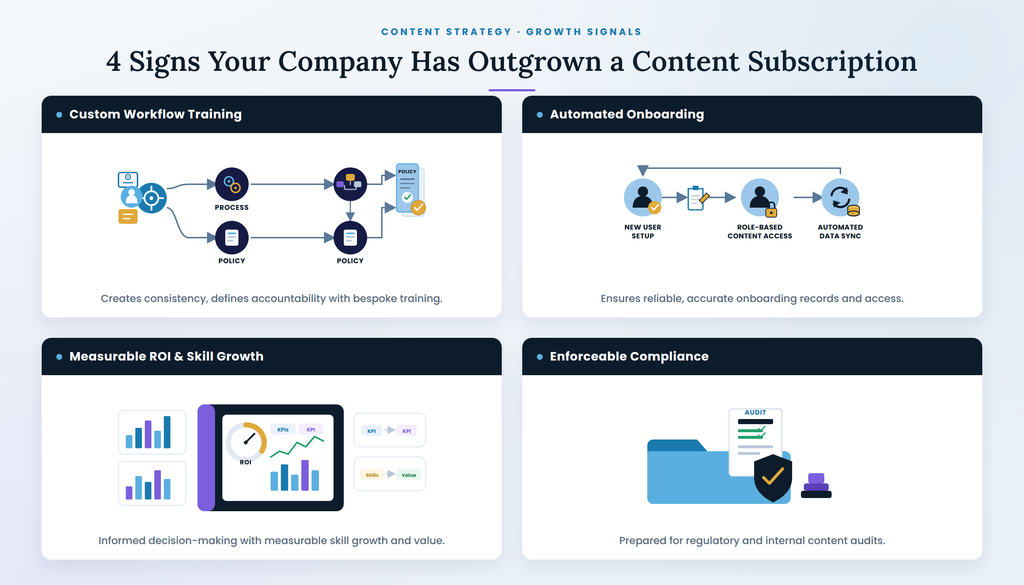
4 Signs Your Company Has Outgrown a LinkedIn Learning Subscription
If your leadership team is experiencing any of the following operational friction points, you have crossed the threshold where a content subscription is no longer sufficient.
You Need to Train People on Your Specific Way of Working
Generic best practices only go so far. When your operational scaling depends on employees mastering your internal AI usage policies, custom tech stacks, or proprietary sales methodologies, you need an infrastructure that hosts and enforces your own materials.
Onboarding is a Manual Administrative Burden
If HR managers and department heads are still manually sending emails with attachments, links, and spreadsheets to every new hire, your onboarding process is unscalable. You need automated workflows that assign, schedule, and track onboarding milestones from day one.
Executive Leadership Demands Proven ROI Beyond “Hours Watched”
When the Chief Financial Officer asks for proof of capability growth, presenting a chart of total video view-time is an immediate red flag. According to industry data, companies using structured learning infrastructure achieve their strategic KPIs. 3.2x more often than those relying solely on content libraries. Leadership needs actionable data showing baseline skill increases, completed practical milestones, and verified competency.
Mandatory Compliance & Governance Training is Unenforceable
Whether managing SOC 2 readiness, data privacy regulations, or internal risk frameworks, relying on voluntary video platforms leaves your organization exposed. You require an administrative audit trail with automated reminders and completion enforcement.
Choosing a learning strategy doesn’t always require an “either/or” decision. Modern corporate L&D architectures frequently integrate content libraries into an enterprise LMS. By connecting LinkedIn Learning to a central LMS via standard SCORM or LTI protocols, the LMS remains the administrative brain—controlling pathways, tracking compliance, and generating executive reports—while pulling in third-party video courses as supplementary electives.
How WeCloudData Solves Both Challenges
The primary challenge growing companies face when evaluating platforms is choosing between an empty software framework (a traditional LMS) and an unmanaged video catalog (LinkedIn Learning).
WeCloudData bridges this gap by providing an enterprise-grade LMS infrastructure paired with pre-built, high-impact technical and AI learning pathways.
Rather than managing disconnected tools, WeCloudData LMS provides:
- Enterprise LMS Infrastructure: Deploy automated, role-based learning tracks, centralize internal company documentation, and track skill growth across divisions from a single dashboard.
- Pre-Loaded, Practical Content: Access curated, continuously updated pathways in AI automation, data analytics, and modern technical workflows—eliminating the need to build technical content from scratch.
- Interactive Applied Sandboxes: Move past passive video consumption. WeCloudData incorporates hands-on execution environments directly inside the platform, ensuring employees build and test real-world workflows as they learn.
WeCloudData delivers the administrative rigor C-level executives demand alongside the practical, applied content workforces need to stay competitive.
A content subscription inspires curiosity, but only an administrative system drives operational capability. If your organization is scaling rapidly, stop attempting to manage talent development through passive video libraries and manual tracking sheets. Match your investment to your true strategic goal: buy content for personal enrichment, but build infrastructure for enterprise execution.
Transform your talent strategy from unmonitored video watch-time into a structured, enterprise-wide capability system. Book an Executive Demo with WeCloudData to evaluate our LMS infrastructure and role-based learning pathways.
Frequently Asked Questions (FAQ)
Yes, if you need to train employees on internal company processes, automate onboarding, or track verified skill capabilities. LinkedIn Learning provides broad off-the-shelf content, but an LMS provides the administrative system needed to assign, govern, and measure custom organizational learning.
Yes. Most enterprise LMS platforms support direct integration with LinkedIn Learning via SAML, SSO, or LTI standards. This enables learners to access catalog content directly within your LMS while your HR team maintains centralized completion analytics.
LinkedIn Learning contains generic, industry-standard courses. It cannot host your company’s unique operational SOPs, proprietary tool guides, team workflows, or culture guidelines, nor can it automatically gate onboarding progress by department.
LinkedIn Learning typically charges per-seat subscription fees for access to its video library. An LMS fee covers the software infrastructure platform, enabling you to host unlimited custom content, automate workflows, and manage enterprise-wide compliance.
Works Cited
Bersin, Josh. “New Research: How AI Transforms $400 Billion of Corporate Learning.” Josh Bersin, 2 Feb. 2026, joshbersin.com/2026/02/new-research-how-ai-transforms-400-billion-of-corporate-learning/.
IBM. AI Adoption Report. IBM, www.ibm.com/reports/ai-adoption.
LinkedIn. Talent Velocity Report. LinkedIn, learning.linkedin.com/resources/talent-velocity-report.
LinkedIn. Workplace Learning Report. LinkedIn, learning.linkedin.com/resources/workplace-learning-report.
McKinsey & Company. The State of AI. McKinsey QuantumBlack, www.mckinsey.com/capabilities/quantumblack/our-insights/the-state-of-ai.
Microsoft. “AI at Work Is Here. Now Comes the Hard Part.” Work Trend Index, Microsoft, 2024, www.microsoft.com/en-us/worklab/work-trend-index/ai-at-work-is-here-now-comes-the-hard-part.
Microsoft. Work Trend Index. Microsoft, www.microsoft.com/worklab/work-trend-index.
Thrive Learning. “LMS vs. Content Libraries: Why Your Business Needs Both (and How to Pitch It to Your Boss).” Thrive Learning Blog, www.thrivelearning.com/blog-news/lms-vs-content-libraries-why-your-business-needs-both-and-how-to-pitch-it-to-your-boss.
World Economic Forum. The Future of Jobs Report 2025. World Economic Forum, 2025, www.weforum.org/reports/the-future-of-jobs-report-2025/.
