
Key Takeaways
- Most LMS comparisons focus on features instead of usability and real-world workflows.
- The origin of an LMS often influences how well it supports learning operations.
- Practitioner-built platforms tend to reduce administrative effort and improve adoption.
- Evaluating product design philosophy can be just as important as comparing feature lists.
- WeCloudData LMS was built from real programme delivery experience, shaping a platform designed for practical learning management rather than feature accumulation.
Feature Checklist Problem
Search for “best LMS,” and you will find an endless sea of identical comparison tables.
They compare the same standard parameters, such as SCORM compliance and course creation features, reporting dashboards, user interface, pricing tiers, and integration counts.
These comparisons are useful during procurement, but they rarely answer the question that determines whether a platform will actually succeed after implementation:
Who built this platform, and what problem were they actually trying to solve?
Two Learning Management Systems (LMS) can offer nearly identical feature lists, yet deliver completely opposite operational experiences. The best LMS isn’t necessarily the one with the longest feature checklist. It’s the one built by people who understand the day-to-day realities of delivering, managing, and scaling learning programs.
The Trap of Feature-First Comparisons
Procurement processes naturally default to measuring what is easiest to count: course builders, reporting features, and integration badges. But high feature counts often obscure product design philosophy.
Consider this common discrepancy between software specs and workplace reality:
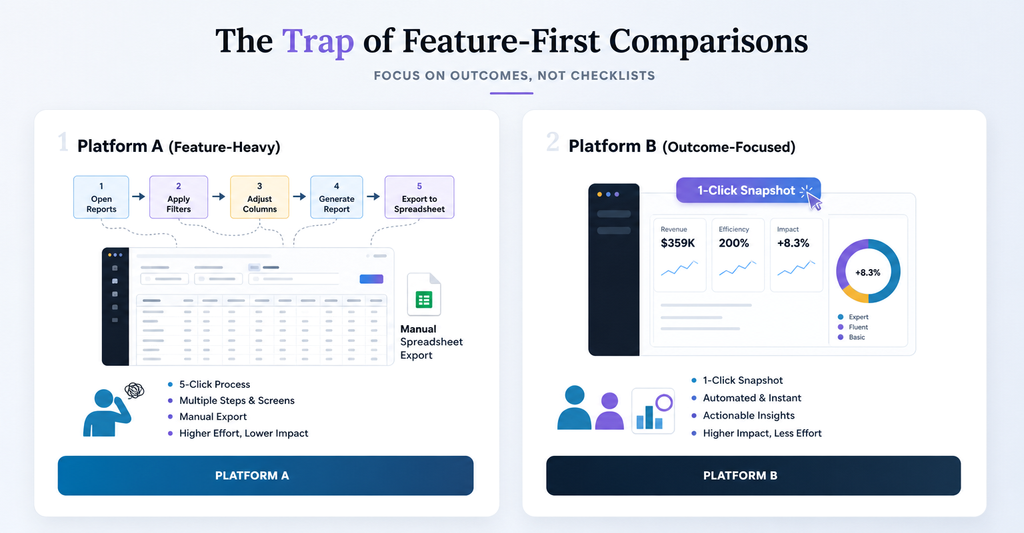
- On Paper: Both Platform A and Platform B advertise “Manager Tracking & Analytics.”
- In Practice: Platform A requires five clicks, manual data filtering, and an export to Excel to view team progress. Platform B delivers a 1-click snapshot designed for quick manager review.
When platforms are built to satisfy feature checklists rather than operational workflows, friction accumulates. Industry research consistently highlights the disconnect between software capability and real-world adoption. According to research by the Brandon Hall Group, complex user interfaces and poor administrative experience remain leading drivers behind enterprise systems changes.
The Practitioner Question
Every software product reflects the mindset of the team that created it. Some LMS platforms are built primarily as pure software products designed by engineering teams aiming for market coverage. Others evolve out of organizations that deliver live learning programs every single day.
When a platform is designed by learning practitioners, the product prioritizes operational efficiency:
- Faster cohort setup over endless nested configuration menus.
- Streamlined learner pathways over cluttered UI dashboards.
- Actionable skill metrics over vanity completion numbers.
- Automated workflows that reduce day-to-day administrative strain.
What Real Delivery Design Looks Like in Practice
When a platform is built around operational reality, the day-to-day experience changes across every role in the learning ecosystem:
| Role | Feature-First Design (Friction) | Practitioner Design (Flow) |
| L&D Admins | Multi-step manual workflows for cohort management and tracking. | Automated administrative routine tasks that free up strategic time. |
| Instructors | Spending class time managing complex technology interfaces. | Technology stays in the background so the focus remains on instruction. |
| Learners | Navigating clunky menus just to find assigned coursework. | Clear pathways that make starting and continuing learning effortless. |
| Managers | Requesting L&D support to export static spreadsheet reports. | Direct, real-time visibility into team progress and skill acquisition. |
| Executives | Receiving vanity metrics (e.g., total login hours). | Clear reporting linked to capability building and business outcomes. |
The Hidden Costs of Buying on Features Alone
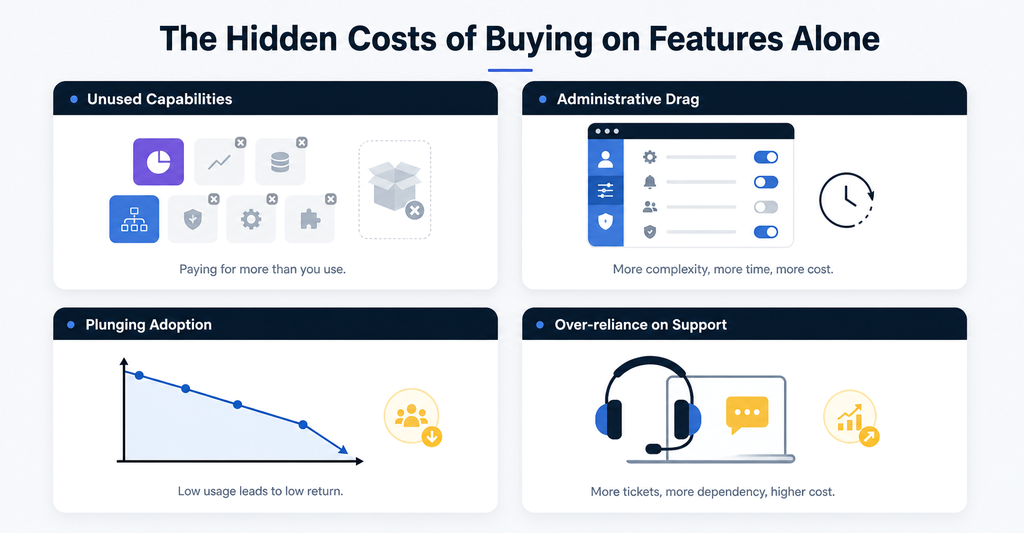
Buying software based on a checklist often leads to post-launch challenges. Gartner research indicates that low end-user adoption and excessive system complexity are major barriers to realizing value from enterprise software investments. Organizations that fail to simplify implementations and support continuous user adoption often struggle to achieve expected business outcomes.
Common operational issues include:
- Unused Capabilities: Features exist technically but are too complex for non-admin users to operate.
- Administrative Drag: L&D teams spend more time managing system settings than improving course content.
- Plunging Adoption: Clunky navigation causes learners to drop off, reducing program completion rates.
- Over-reliance on Support: Routine administrative updates require vendor intervention.
The Buyer’s Evaluation Framework
When evaluating an LMS, consider moving beyond traditional comparison tables and asking these six structural questions:
- Origin: Was this platform designed by pure software engineers or learning operators?
- Efficiency: Does this workflow reduce administrative tasks or add steps?
- Usability: Will instructors, managers, and learners find the system straightforward to use?
- Scalability: How seamlessly does the platform manage multi-cohort setups as programs grow?
- Analytics: Are reports built for compliance checkboxes or executive capability tracking?
- Design Intent: What real-world classroom challenge shaped this specific feature?
The WeCloudData Story: Built From the Classroom Up
WeCloudData was not created by a software incubator looking for an industry to enter. It was developed to support the delivery of intensive, technical, and live learning programs.
As WeCloudData scaled its live training offerings, the team faced the same operational hurdles that L&D teams encounter daily:
- Managing dynamic cohorts and schedules.
- Integrating video, hands-on environments, and progress tracking.
- Supporting instructors without increasing tech complexity.
- Providing real-time capability insights to corporate stakeholders.
Rather than stacking disparate software tools together, WeCloudData developed an LMS around these practical operational needs. Because it was shaped by active classroom delivery, its workflows reflect how learning actually occurs in practice.
Delivering Learning at Scale Without the Operational Drag
The goal of enterprise training is to build real capability across the workforce. McKinsey & Company argues that organizations need to shift from traditional training programs toward capability building that is tightly aligned with strategic business priorities, embedding learning into day-to-day work rather than treating it as a standalone activity.
By focusing on operational design, WeCloudData balances core management tools with an accessible user experience:
- Structured Learning Pathways: Unifying live instruction, self-paced modules, and practical assessments.
- Capability Mapping: Moving past completion tracking to measure actual skill application.
- Streamlined Administration: Reducing manual setup tasks so L&D teams can focus on program strategy.
Feature comparison tables have their place in procurement, but they shouldn’t be the sole deciding factor. Software should support the teams running learning programs—not force them to adapt to unnecessary technological friction. When evaluating your next LMS, look beyond the feature count and ask whether the system was built by people who understand the work you do every day. Choose an LMS Built for Real Learning.
Ready to look beyond feature checklists? Discover how WeCloudData’s LMS was built through years of delivering live, technical learning programs—helping organizations reduce administrative complexity and scale workforce capability. Book a Demo Today.
Frequently Asked Questions
Companies should evaluate more than features. They should consider usability, scalability, reporting capabilities, administration effort, and whether the platform supports real learning workflows.
Many LMS implementations struggle because organisations choose platforms based mainly on feature lists without considering adoption, user experience, workflow complexity, and long-term operational needs.
A practitioner-built LMS is designed from real learning delivery experience. It focuses on solving practical challenges faced by learners, instructors, administrators, and managers.
Not necessarily. The best LMS is the one that supports the organisation’s learning goals, reduces complexity, and helps teams achieve measurable outcomes.
WeCloudData was developed around real programme delivery needs, helping organisations manage learning experiences, track progress, and scale capability development through a unified platform.
Works Cited
“Building Capabilities for Performance.” McKinsey & Company, 1 Jan. 2015, www.mckinsey.com/capabilities/people-and-organizational-performance/our-insights/building-capabilities-for-performance. Accessed 18 Nov. 2026.
Colman, Miriam. “6 Trends Shaping Technology Adoption ROI for Software Engineering.” Gartner, 21 May 2026, www.gartner.com/en/articles/technology-adoption-roi. Accessed 18 Nov. 2026.
“Enterprise Resource Planning to Optimize Operations.” Gartner, www.gartner.com/en/information-technology/topics/enterprise-resource-planning. Accessed 18 Nov. 2026.
“Learning Systems Comparison.” Fosway Group, 23 Mar. 2026, www.fosway.com/9-grid-2/learning-systems/. Accessed 18 Nov. 2026.
Poynton, Shannon, et al. “2026 Global Human Capital Trends.” Deloitte Insights, 4 Mar. 2026, www.deloitte.com/us/en/insights/topics/talent/human-capital-trends.html. Accessed 18 Nov. 2026.
“Workplace Learning Report 2025.” LinkedIn Learning, 2025, business.linkedin.com/learn/resources/workplace-learning-report. Accessed 18 Nov. 2026.
