
Key Takeaways
- Multiple learning platforms often create unnecessary cost and administrative complexity.
- Fragmented learning data makes it difficult to measure workforce capability.
- Consolidating learning into one platform improves reporting, learner experience, and operational efficiency.
- Organisations can still use external content libraries while managing learning through a central LMS.
- WeCloudData LMS helps organisations simplify their L&D stack with one platform for learning, tracking, and workforce development.
How Organisations End Up With Three Learning Platforms
It usually starts with noble intentions.
First, your HR department licenses a legacy Learning Management System (LMS) to deliver mandatory compliance training and track annual workplace safety certifications. A year later, your engineering leads complain that the LMS lacks modern technical content, so the company approves a bulk subscription to a specialized video catalog like Udemy Business. Shortly after, HR adds LinkedIn Learning to support soft-skills development, leadership tracks, and general professional growth.
On an executive slide deck, this setup looks like a comprehensive enterprise learning strategy. You have compliance covered, technical skills supported, and soft skills accessible on demand.
In reality, you have built a fragmented L&D stack, a patchwork of overlapping software subscriptions, isolated data silos, and administrative friction.
The hidden operational cost of running three separate learning platforms—in redundant seat licensing, lost administrative hours, data reconciliation nightmare, and platform fatigue—is vastly
higher than most corporate leaders realize.
The Hidden Costs of the “Multi-Subscription” Fallback
While buying separate point solutions feels like a flexible compromise, it introduces structural inefficiencies that quietly drain your budget and undermine workforce development.
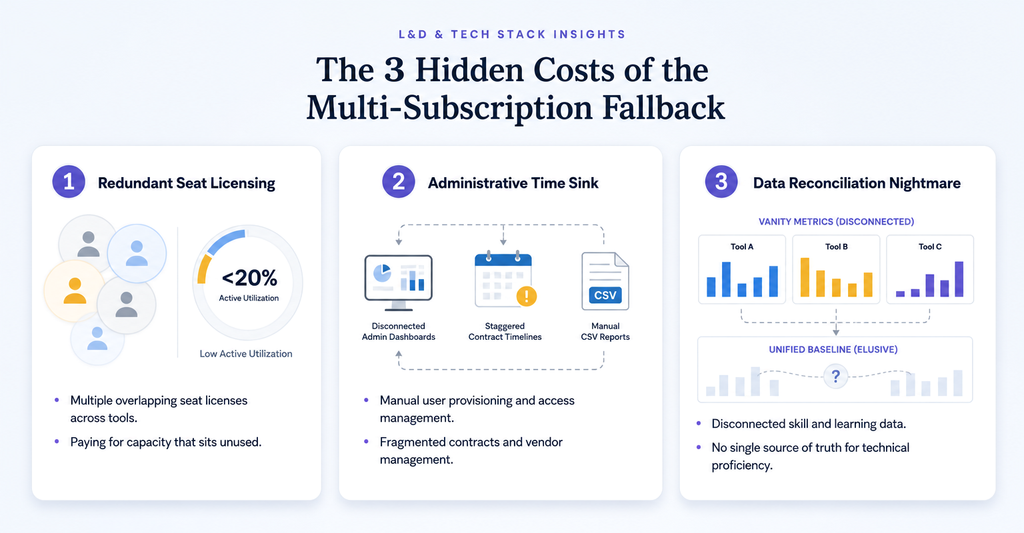
1. Redundant Seat Licensing & Low Active Utilization
When you subscribe to multiple platforms, you pay for duplicate seat allocations across overlapping user bases.
An employee might hold an active license on your compliance LMS, a seat on Udemy Business, and an active profile on LinkedIn Learning. Yet, enterprise learning platforms frequently experience low engagement, particularly when they serve as secondary or optional learning destinations. Published enterprise LMS benchmarks report a median monthly active usage rate of approximately 23% for non-mandatory learning, with considerably lower engagement observed in some organizations. As a result, organizations often pay full per-seat SaaS subscription costs for licenses that employees rarely use, creating costly “shelfware.”
2. The Administrative Time Sink
Managing multiple vendor portals requires constant manual overhead:
- IT teams spend hours managing separate user provisioning, SSO syncs, and seat reassignments across three distinct admin dashboards.
- HR and L&D specialists spend days every quarter pulling raw CSV files from multiple portals, trying to manually clean and stitch together completion records into a single executive report.
- Procurement teams waste time managing staggered renewal cycles, complex usage minimums, and disparate vendor contracts.
3. The Data Reconciliation Nightmare
If your Chief Technology Officer or VP of HR asks a fundamental business question—”What is the actual technical proficiency of our data engineering team today?”—a fragmented stack cannot provide an answer.
One platform tracks compliance completion percentages, another records video watch time in hours, and a third tracks self-reported course completions. None of them communicate natively, leaving leadership with a chaotic mix of vanity metrics instead of a unified, verifiable baseline of workforce capabilities.
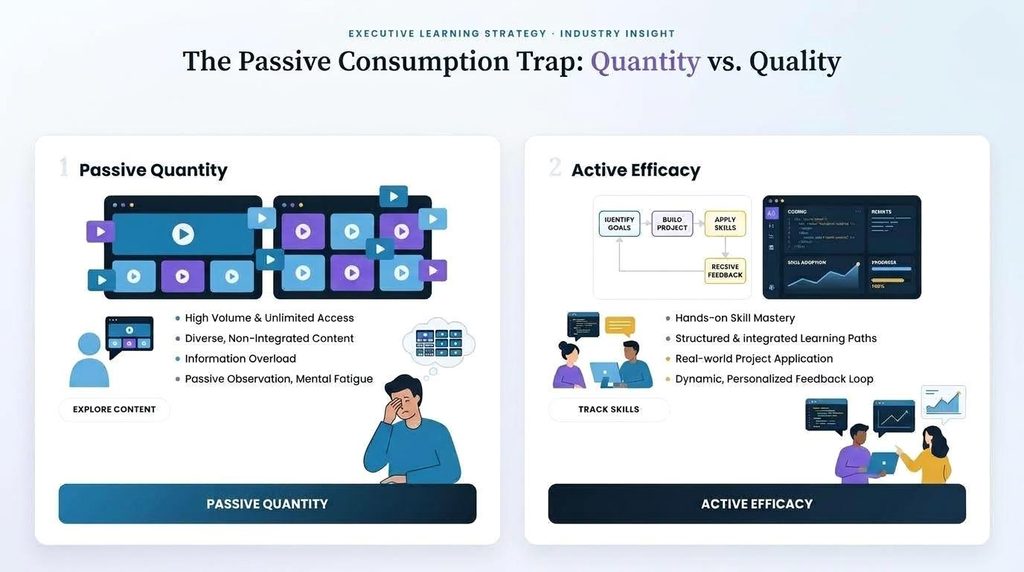
4. The “Passive Consumption Trap”: Quantity vs. Quality of Learning
Beyond financial and administrative waste, the biggest casualty of a fragmented L&D stack is learning efficacy.
Platforms like Udemy and LinkedIn Learning offer massive libraries with tens of thousands of video courses. However, watching a 10-minute video on Python syntax or prompt engineering does not make an employee capable of writing production-ready code or building an enterprise workflow.
When an organization stacks passive video libraries on top of a basic compliance LMS, they pay multiple platform fees for surface-level engagement. Employees suffer from platform fatigue—constantly context-switching between different portals, forgetting login details, and ultimately abandoning courses halfway through.
The Business Case for LMS Consolidation
LMS consolidation isn’t just about cutting software subscriptions—it is about fundamentally changing how your organization builds and measures talent.
| Strategic Axis | Fragmented 3-Platform Stack | Consolidated Learning Ecosystem |
| Financial Cost | High (3x subscription fees + high admin overhead) | Optimized (Single predictable platform tier) |
| User Experience | Confusing (Fragmented logins, platform fatigue) | Frictionless (One interface for all learning) |
| Skill Assessment | Passive (Video watch time & completion checks) | Active (In-browser labs, code execution, projects) |
| Data Visibility | Siloed (Disparate CSV exports & vanity metrics) | Unified (Real-time dashboard of true capabilities) |
| Admin Effort | Heavy (Manual data reconciliation & user management) | Streamlined (Automated tracking & single provisioning) |
By replacing a patchwork of point solutions with a single, comprehensive platform, organizations unlock three major advantages:
- Lower Total Cost of Ownership (TCO): Eliminating redundant seat licenses and vendor markups immediately frees up L&D budget.
- Single Source of Truth: Executive leadership gains a single pane of glass showing real-time skill acquisition, completion rates, and assessment scores across all teams.
- Higher Employee Engagement: Employees log into one interface for on-demand learning, hands-on practice, and progress tracking.
How to Audit Your L&D Stack in 4 Steps
If you suspect your organization is overpaying for a fragmented learning stack, run this quick internal audit:
- Calculate Your True Seat Utilization: Compare the total number of paid licenses across Udemy, LinkedIn Learning, and your LMS against actual Monthly Active Users (MAU) over the last 90 days.
- Quantify Admin Hours: Ask your HR or L&D team how many hours they spend every month pulling CSVs, sync-checking user seats, and manually stitching together completion reports.
- Evaluate Content Depth vs. Practical Application: Audit whether your current tools provide interactive sandboxes for technical practice or if they rely purely on passive video streams.
- Schedule a Consolidation Assessment: Partner with a platform provider that can combine content, hands-on labs, and unified tracking into a single cost-effective agreement.
The WeCloudData Model: Replacing Tool Sprawl with a Complete Ecosystem
At WeCloudData, we designed our enterprise learning environment to solve the exact pain points created by fragmented L&D stacks.
Instead of forcing your organization to subscribe to a compliance LMS, a separate video library, and a third-party coding sandbox, WeCloudData LMS unifies the entire learning lifecycle into one consolidated, interactive ecosystem
- Curated, Role-Based Pathways: Eliminate content overload. WeCloudData provides structured, expert-designed learning paths for Data, AI, Cloud, and Business Operations roles.
- Unified Admin Analytics: Monitor team progress, assessment scores, and practical project completions in real time through a single, clean administrative dashboard.
Ready to Simplify Your L&D Stack? Stop paying for low-utilization video subscriptions and disconnected learning tools. Discover how WeCloudData can help you eliminate tool sprawl, reduce administrative overhead, and deliver verifiable skill growth across your organization. Book a Personalized LMS Demo & Strategy Call.
Frequently Asked Questions
LMS consolidation is the process of replacing multiple learning platforms with a single system that manages learning, reporting, and workforce development.
Different departments often purchase tools independently to solve immediate learning needs, leading to duplicated systems and fragmented learning experiences.
They increase software costs, administrative workload, reporting complexity, and make it difficult to gain a complete view of employee learning.
Yes. Many organisations integrate external content libraries into a central LMS while managing assignments, reporting, and learning pathways from one platform.
WeCloudData LMS combines curated learning content, role-based pathways, reporting, analytics, and learning management into one platform, reducing complexity while improving workforce visibility
Works Cited
Deloitte. “2026 Global Human Capital Trends: From Tensions to Tipping Points—Choosing the Human Advantage.” Deloitte Insights, 4 Mar. 2026, https://www.deloitte.com/us/en/insights/topics/talent/human-capital-trends.html.
Stempel, Jen, et al. “Leveraging Learning Analytics to Drive Business Impact.” Deloitte, 3 Apr. 2023, https://www.deloitte.com/us/en/services/consulting/blogs/human-capital/learning-analytics-to-drive-business-impact.html.
Mordor Intelligence. “Learning Management System (LMS) Market Size and Share Analysis 2031.” Mordor Intelligence, https://www.mordorintelligence.com/industry-reports/learning-management-system-market. Accessed 10 Nov. 2026.
Pittman, Matt. “How to Get Started with Learning Analytics.” Brandon Hall Group, 18 June 2024, https://brandonhall.com/how-to-get-started-with-learning-analytics/.
Rochelle, Michael. “Data-Driven L&D: Leveraging Measurement and Analytics.” Brandon Hall Group, 17 June 2025, https://brandonhall.com/data-driven-ld-leveraging-measurement-and-analytics.
TouchClass. “Corporate LMS Usage Benchmarks: 107 Companies.” TouchClass, https://www.touchclass.com/en/lms-benchmark. Accessed 10 Nov. 2026.
Wentworth, David. “Building the Next-Generation Learning Technology Ecosystem.” Brandon Hall Group, 23 May 2022, https://brandonhall.com/building-the-next-generation-learning-technology-ecosystem/.
