
Key Takeaways
- Why Managers Never Know Their Team’s Training Status (And What That Is Costing You)
- Managers cannot effectively develop their teams without visibility into learning progress and capability gaps.
- Traditional LMS systems often prioritise HR administration over manager decision-making.
- Lack of training creates slower skill development, compliance risks, and unnecessary HR workload.
- Real-time manager dashboards enable better coaching, accountability, and workforce planning.
- WeCloudData LMS helps organisations give managers actionable learning insights through self-service dashboards, tracking, and analytics.
The End of Quarter Surprise
An engineering manager conducts a quarterly performance review or investigates a missed milestone, only to discover the employee never completed the mandatory security protocol or AI tool onboarding module.
This scenario plays out daily across mid-market enterprises. Managers typically find out about training gaps after they manifest as project delays, security risks, or performance failures—never before.
The root cause isn’t manager apathy; it’s an architectural flaw in how software is deployed. Legacy Learning Management Systems (LMS) were engineered as compliance vaults for HR administrators to log completion records for audits. They were never designed as operational platforms for managers who direct daily workflows.
According to Gallup, managers account for at least 70% of the variance in employee engagement across business units. Yet, in most organizations, these exact leaders are completely blind to their team’s learning progress. When managers are locked out of real-time visibility, capability development stalls, administrative cost explodes, and corporate training fails to deliver business ROI.
Why L&D Systems Leave Managers in the Dark
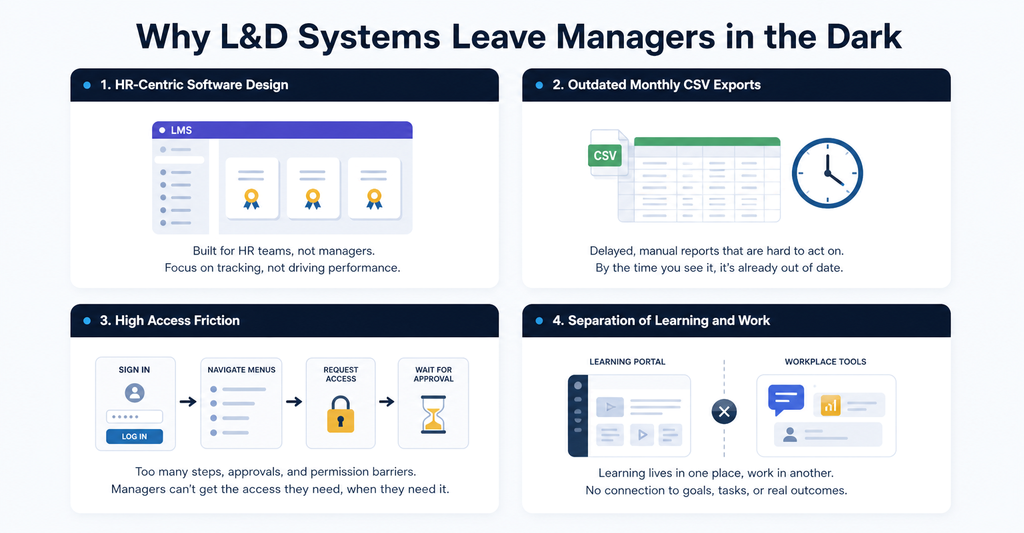
Despite millions invested in enterprise upskilling, managers remain functionally disconnected from their team’s learning lifecycle due to four systemic barriers:
HR-Centric Software Design
Traditional LMS platforms were built to satisfy HR compliance requirements. They serve as static repositories for completion certificates rather than operational dashboards designed to help a manager assign work based on verified skills.
Outdated Monthly CSV Exports
Because managers lack direct access, HR routinely exports massive spreadsheets to email across departments. By the time a manager receives, filters, and reads an attached CSV, the completion data is already obsolete.
High Access Friction
If checking an employee’s skill status requires a manager to navigate complex HR administration menus, request permissions, or submit a request, busy department heads simply won’t do it.
Separation of Learning and Work
Training activity occurs in an isolated portal, completely disconnected from daily sprint planning, task allocation, and 1-on-1 coaching sessions.
The Hidden Costs of Manager Blindness
When managers cannot track learning progress in real time, the organization incurs significant costs:
1. Failed Learning Transfer (Project Delays)
Research published by the Association for Talent Development (ATD) indicates that up to 80% of corporate training is ineffective when employees cannot immediately apply lessons in their work environment. Without visibility into who has completed specific modules, managers assign tasks blindly, leading to rework and operational bottlenecks.
2. Unmanaged Compliance & Security Risks
When managers cannot track compliance deadlines in real time, uncompleted safety, data governance, or SOC 2 modules expose the enterprise to audit penalties and security breaches simply because no one on the ground was tracking cutoff dates.
3. Excessive HR Administrative Overhead
HR teams spend hundreds of hours annually acting as manual report generators, responding to repetitive queries like “Has John completed the security clearance course yet?” or manually assembling slide decks for executive syncs.
4. The Manager Support Barrier
LinkedIn’s Workplace Learning Report highlights that 50% of talent leaders view a lack of manager support as a primary barrier to workforce development. Furthermore, CIPD research found that only 36% of line managers actively support their teams in transferring L&D learning back to the workplace. Managers aren’t ignoring training. They are structurally blocked from supporting it.
What Changes When Managers Have Real-Time Visibility?
Providing managers with self-serve learning visibility transforms how upskilling functions across team operations:
| Operational Scenario | Legacy HR Setup (No Visibility) | Self-Serve Manager Dashboard Setup |
| Tracking Progress | Requests monthly CSV exports from HR | Opens live dashboard; sees real-time completion status |
| 1-on-1 Meetings | Vague check-in: “How is that training going?” | Data-backed coaching: “I see you finished Module 2; let’s apply it to Project X.” |
| Task Allocation | Guesses team capability based on tenure | Assigns tasks based on verified module completion and assessment scores |
| Compliance Audits | Surprised by audit flags or expired certs | Receives automated alerts 14 days before a deadline breaches |
4 Features Every Effective LMS Manager Dashboard Must Have
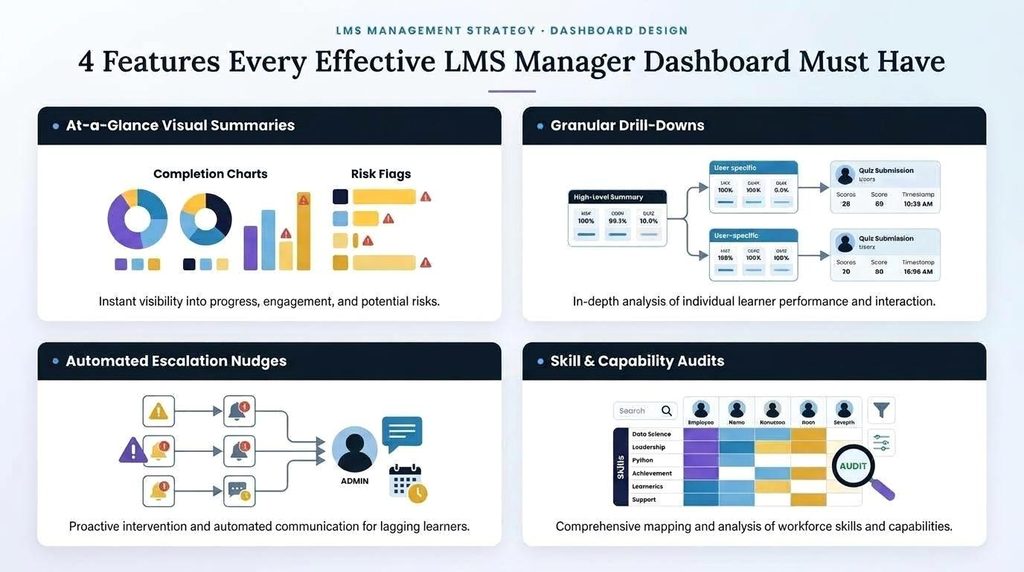
To bridge the gap between HR compliance and daily team execution, an LMS manager dashboard must include four core capabilities:
- At-a-Glance Visual Summaries: Clear status indicators (completion percentages, red/yellow/green risk flags) that show department readiness in under 5 seconds.
- Granular Drill-Downs: The ability to review team metrics and instantly click through to view individual quiz scores and practical project submissions.
- Automated Escalation Nudges: Automated alerts sent directly to managers (via email, Slack, or Teams) when a direct report falls behind on a mandatory deadline.
- Skill & Capability Audits: A searchable matrix showing which team members possess verified, competencies for immediate project staffing.
How WeCloudData (WCD) Gives Managers Real-Time Control
The WeCloudData LMS platform eliminates administrative silos by providing dedicated, self-serve manager portals alongside enterprise HR admin controls. WeCloudData bridges the gap between training and daily performance by delivering:
- Live Progress Dashboards: Real-time visibility into team completion rates, assessment scores, and engagement trends without requesting HR exports.
- Automated Nudges & Alerts: Automatically remind employees and escalate upcoming deadline cutoffs directly to line managers.
- Verified Practical Capability: Managers see real-world outputs from WeCloudData’s interactive technical sandboxes rather than just video watch-time.
- Unified HR & Department Alignment: Empowers managers to take ownership of team upskilling while providing HR with automated executive reporting.
Stop treating manager visibility as an afterthought. Gallup data reveals managers drive 70% of employee engagement variance—equipping them with live data transforms employee training from an administrative burden into a business superpower. When managers have self-serve, real-time insights, learning ceases to be an isolated HR activity. It becomes a predictable driver of team performance, project speed, and organizational capability.
Ready to eliminate manual spreadsheet tracking and empower your department heads with real-time learning insights? [Discover how WeCloudData’s manager dashboards turn employee upskilling into a predictable, measurable growth engine. Book a demo today.]
Frequently Asked Questions (FAQ)
Many learning systems are built for HR administration rather than manager visibility, leaving managers dependent on manual reports.
An LMS manager dashboard gives leaders real-time visibility into employee training progress, completion status, compliance, and skills development.
Managers can identify skill gaps earlier, support employee growth, and prevent training issues from becoming performance problems.
Managers should see team progress, overdue training, assessments, certifications, and capability development insights.
WeCloudData LMS provides self-service dashboards, learning analytics, and visibility that help managers actively support workforce development.
Works Cited
Association for Talent Development. “Overview of Executive Dashboards for Learning and Development (L&D).” ATD, https://www.td.org/education-courses/l/micro-course/overview-of-executive-dashboards-for-learning-and-development-l-and-d. Accessed 5 Nov. 2026.
Brandon Hall Group. “Reporting and Your LMS.” Brandon Hall Group, 20 Mar. 2013, https://brandonhall.com/reporting-and-your-lms/.
Connolly, Fergal. “Evidence-Based Design That Leads to Learning Transfer.” ATD, 16 Nov. 2020, https://www.td.org/content/atd-blog/evidence-based-design-that-leads-to-learning-transfer.
Lancaster, Andy. “How L&D Can Create Value: Focusing on Skills Development.” CIPD, 4 Nov. 2024, https://www.cipd.org/en/views-and-insights/thought-leadership/insight/learning-value-skills-development.
D2L. “Employee Training Statistics and Trends to Know in 2026.” D2L, 30 June 2026, https://www.d2l.com/blog/employee-training-statistics/.
Health & Safety Institute. “How to Build Learning Buy-In from Leaders.” HSI, https://hsi.com/blog/how-to-build-learning-buy-in-from-leaders. Accessed 5 Nov. 2026.
LinkedIn Learning. “The Rise of Career Champions: Workplace Learning Report 2025.” LinkedIn Learning, https://business.linkedin.com/learn/resources/workplace-learning-report. Accessed 5 Nov. 2026.
