
Key Takeaways
- AI readiness does not mean every employee becoming an AI engineer; it means employees can confidently apply AI within their own roles.
- Mid-market technology companies need practical, role-based AI capability programmes rather than complex enterprise transformation initiatives.
- Successful AI adoption requires assessment, structured learning pathways, workplace application, and continuous measurement.
- AI training should focus on capability development and business outcomes, not just course completion.
- WeCloudData LMS helps growing companies build AI capability through curated content, role-based learning pathways, and workforce analytics.
AI Readiness Looks Different for Mid-Market Companies
Most mid-market tech executives have sat through at least one internal demo that felt like magic: an engineer uses an AI agent to spin up a boilerplate API in 90 seconds, or a marketer drafts a month’s worth of lifecycle emails in five minutes. Yet when leadership looks at quarter-end operational metrics, the overall output hasn’t moved the needle.
Most advice on AI workforce transformation is written with global enterprises in mind—organizations with thousands of employees, dedicated AI centres of excellence, and multimillion-dollar transformation budgets. A 500-person technology company operates very differently. Teams are leaner, employees often wear multiple hats, and Learning & Development (L&D) resources are limited.
This friction points to a growing reality across the mid-market sector: Having hundreds of enterprise LLM licenses does not mean you have an AI-ready workforce. While the tools differ, the objective is the same: helping employees work smarter while using AI responsibly.
This distinction is becoming increasingly important as AI adoption accelerates. According to Microsoft’s 2024 Work Trend Index, 75% of knowledge workers now use AI at work, yet many employees are bringing their own AI tools into the workplace without formal guidance or organizational support—a trend Microsoft describes as “Bring Your Own AI (BYOAI).” Without structured governance and learning, organizations risk inconsistent practices, security concerns, and uneven capability across teams (Microsoft & LinkedIn, 2024).
For mid-market companies, the challenge is no longer deciding whether employees will use AI.
It’s ensuring they use it effectively, securely, and consistently. True workforce readiness is not measured by prompt frequency or software seat adoption. It is measured by process redesign, output verification, and operational governance.
What Does “AI-Ready” Actually Mean?
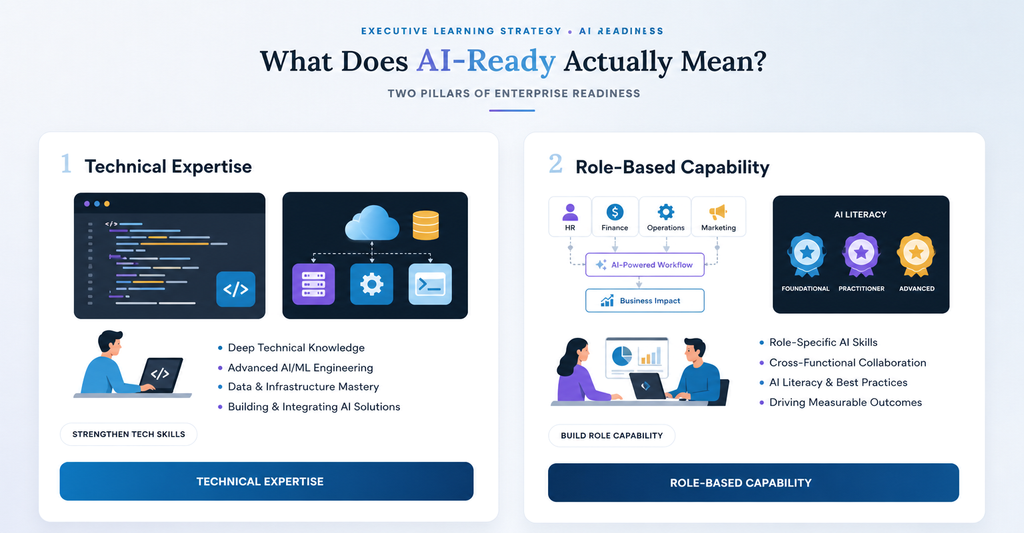
One of the biggest misconceptions surrounding AI readiness is that it requires deep technical expertise across the organization.
It doesn’t.
Rather than teaching everyone the same AI concepts, organizations should focus on role-based capability development.
This approach aligns with guidance from the World Economic Forum’s Future of Jobs Report 2025, which identifies AI literacy, analytical thinking, technological literacy, and continuous learning among the fastest-growing workforce capabilities. The report emphasizes that future competitiveness depends not only on hiring technical specialists but also on helping employees across all functions develop practical digital and AI skills.
For a 500-person technology company, success isn’t measured by the number of AI experts employed. It’s measured by how effectively every department can use AI to improve productivity, decision-making, and customer outcomes.
The Anatomy of Mid-Market “AI Illusion”
Consider a hypothetical 500-person technology company: as AI adoption matures, usage often evolves through three stages:
Most mid-market organizations remain trapped in Stage 2: The Enablement Illusion.
RSM’s 2025 Middle Market AI Survey found that 91% of mid-market organizations are using generative AI, yet only 25% have fully integrated it into core operations. Separately, EY’s 2026 Technology Pulse Poll found that 52% of department-level AI initiatives operate without formal approval or oversight, highlighting a gap between AI adoption and governance maturity.
The cause is rarely employee resistance. Instead, it stems from three structural failure points:
- The Skill Shift Misalignment: Leadership focuses on teaching employees how to prompt, when the critical gap is teaching employees how to evaluate, audit, and refine AI outputs. Microsoft’s Work Trend Index research emphasizes that quality control of AI output and critical thinking are now the top human skills required for AI-assisted work. High-performing AI users typically treat LLM outputs as drafts or starting points rather than finished deliverables, using human review and domain expertise to validate, refine, and contextualize AI-generated content (Microsoft Work Trend Index).
- Middle Management Bottlenecks: Line managers, evaluated on weekly deliverables, often view unvetted AI workflows as risk liabilities rather than efficiency levers. Without clear guidelines, managers either block usage or ignore unverified AI-generated content.
- Data and Context Fragmentation: Without structured internal documentation, AI models generate generic, shallow responses that require extensive manual rewriting—defeating the speed advantage.
The Mid-Market AI Workforce Readiness Framework
A truly AI-ready 500-person company structures its workforce across four interdependent pillars, These are our recommeded targets for the following:
| Pillar | Operational Focus | Key Readiness Metric |
| 1. Output Verification | Training employees to audit LLM hallucinations, check edge cases, and maintain domain accuracy. | <5% error rate on AI-assisted external deliverables. |
| 2. Context Architecture | Codifying company IP, style guides, and tech documentation into searchable retrieval systems (RAG). | >80% of team prompts leveraging grounded context repositories. |
| 3. Workflow Redesign | Mapping processes end-to-end to integrate agentic human-in-the-loop checkpoints. | >30% reduction in end-to-end task cycle time. |
| 4. Governance & Safety | Clear policies on data privacy, client code security, and approved AI tools. | 0 data exposure or unvetted shadow-AI incidents. |
Department-by-Department Breakdown
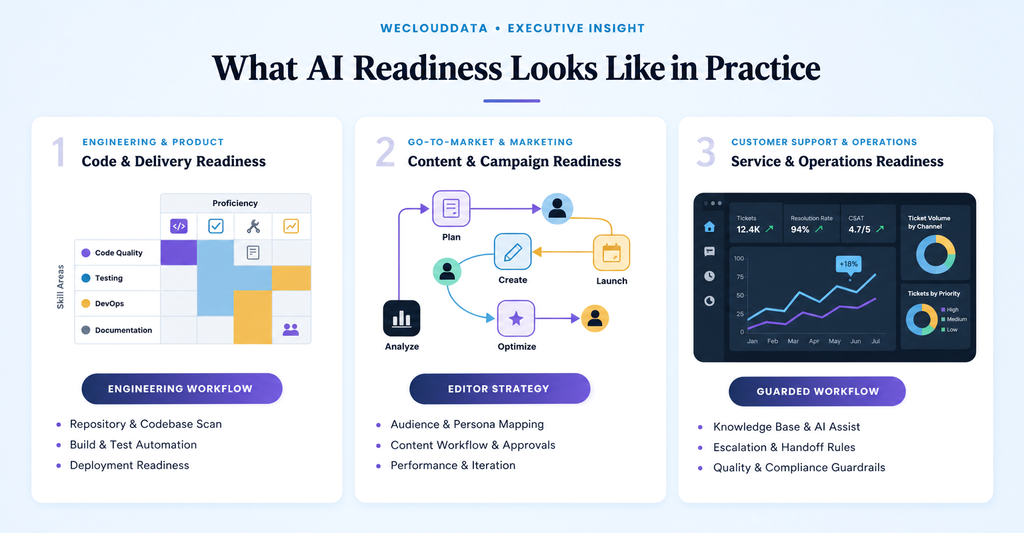
To understand what readiness looks like in practice, consider how functional roles transform in an AI-ready 500-person tech firm:
Engineering & Product
- Unready Team: Engineers use Copilot for inline code autocompletion, but pull request review times remain unchanged because reviewers spend extra time catching subtle synthetic code bugs.
- AI-Ready Team: Developers use AI for boilerplate generation, test-case writing, and refactoring, backed by automated CI/CD evaluation pipelines. Senior engineers transition into system architects who focus on code review standards and security boundary audits.
Go-To-Market & Marketing
- Unready Team: Marketers generate volume-heavy, generic blog posts and social copy that dilute brand authority and require significant editing.
- AI-Ready Team: Content creators act as managing editors. AI handles preliminary research summarizing, competitive positioning analysis, and multi-format derivative drafting allowing human writers to focus on original research, customer interviews, and brand positioning.
Customer Support & Operations
- Unready Team: Support agents paste customer queries into chatbots to construct responses, leading to inconsistent tone and occasional factual hallucinations.
- AI-Ready Team: Tier-1 support runs through guarded multi-agent retrieval workflows. Agents step in as high-empathy escalation managers who resolve complex multi-system issues and continuously refine the underlying knowledge base.
The 90-Day Executive Roadmap for Mid-Market Leaders
If your 500-person organization is stuck in “pilot purgatory”, transitioning to genuine operational readiness requires a deliberate 90-day plan:
1. Months 1-3 Operational Blueprint: Days 1–30: Audit & Policy Standardization
- Execute an inventory audit across all teams to uncover unvetted shadow AI tools.
- Publish a clear, single-page enterprise AI acceptable-use policy covering client data, code privacy, and disclosure rules.
- Define 3 to 5 high-impact business workflows to redesign (e.g., customer onboarding, technical RFP responses, pull request reviews).
Days 31–60: Grounding & Verification Protocols
- Clean and structure internal documentation to ground enterprise models.
- Shift upskilling programs away from basic prompt writing toward AI Output Auditing & Quality Control.
- Establish explicit team norms for human-AI handoffs.
Days 61–90: Workflow Re-engineering & Measurement
- Re-architect selected workflows to integrate AI agents at execution steps while reserving strategic approval for human specialists.
- Track business outcomes using P&L-connected metrics (e.g., ticket resolution velocity, customer turnaround times, software release cycles) rather than seat log-in frequency.
Moving Beyond Seat Licenses to Owned Intelligence
Achieving true AI readiness at a 500-person tech company is not an engineering challenge; it is an organizational discipline challenge. Companies that move past the illusion of simple adoption and focus on structured context, rigorous output verification, and governance turn AI capabilities into a durable competitive moat.
How WeCloudData Helps Mid-Market Companies Build an AI-Ready Workforce
For a 500-person technology company, building AI capability is not about creating a massive enterprise transformation office or deploying dozens of disconnected learning tools.
The challenge is finding a practical system that helps employees develop relevant AI skills while giving leadership visibility into progress.
Most organisations already have three challenges:
- Employees are experimenting with AI independently.
- Learning teams struggle to provide structured, role-relevant development.
- Leadership lacks visibility into whether AI capability is actually improving.
An effective AI workforce programme requires more than content. It requires infrastructure that connects assessment, learning, application, and measurement. This is where a modern learning platform becomes essential.
How WeCloudData LMS Supports AI Capability Development
WeCloudData LMS enables mid-market technology companies to create role-based AI learning pathways, provide curated up-to-date content, track employee capability development, and give leaders clear visibility into workforce readiness. Instead of managing disconnected courses, spreadsheets, and reporting tools, organisations can build a scalable AI capability programme from one central platform.
With WeCloudData LMS, companies can:
- Assess Current AI Capability Levels
- Deliver Role-Based AI Learning Pathways
- Provide Curated AI Learning Content Without Building Everything Internally
- Track AI Capability Development Across the Organisation
Ready to build an AI-ready workforce without the complexity? Explore how WeCloudData LMS helps growing technology companies assess, develop, and measure AI capability across their teams. Book a demo today and turn AI adoption into a measurable workforce advantage.
Frequently Asked Questions
An AI-ready workforce is one where employees understand AI fundamentals, use AI tools responsibly, and apply AI capabilities to improve their specific roles and workflows.
A mid-sized company can build AI skills by assessing current capability, creating role-based learning pathways, providing practical AI training, and measuring progress over time.
No. Most employees need practical AI skills related to their job function, while advanced technical training is only required for specialised AI roles.
AI capability can be measured through skill assessments, confidence improvements, practical application, adoption rates, and business impact—not only course completion.
WeCloudData LMS helps organisations assess AI capability, deliver curated learning pathways, track workforce progress, and provide visibility into AI skill development across teams.
Works cited
Ernst & Young LLP. “EY Survey: Autonomous AI Adoption Surges at Tech Companies as Oversight Falls Behind.” EY, 4 Mar. 2026, https://www.ey.com/en_us/newsroom/2026/03/ey-survey-autonomous-ai-adoption-surges-at-tech-companies-as-oversight-falls-behind.
Gartner. “50% of Enterprises Without a People-Centric AI Strategy Will Lose Their Top AI Talent.” Gartner, 13 May 2026, https://www.gartner.com/en/newsroom/press-releases/2026-05-13-gartner-predicts-by-2027-50-percent-of-enterprises-without-a-people-centric-ai-strategy-will-lose-their-top-ai-talent.
Gartner. [Report title unavailable]. Gartner, https://www.gartner.com/en/documents/7171230. Accessed 10 Nov. 2026.
Microsoft. “Agents, Human Agency, and the Opportunity for Every Organization.” 2026 Work Trend Index Annual Report, 5 May 2026, https://www.microsoft.com/en-us/worklab/work-trend-index/agents-human-agency-and-the-opportunity-for-every-organization.
Okhrem, Paul. “Enterprise AI Agent Statistics 2026: Adoption and Deployment.” Paul Okhrem, 27 Apr. 2026, https://paul-okhrem.com/enterprise-ai-agents-statistics-2026/.
QueryNow. “The Mid-Market AI Advantage: How $50M to $500M Companies Out-Ship the Fortune 500.” QueryNow, 11 June 2026, https://www.querynow.com/resources/whitepapers/mid-market-ai-advantage.
