
Key Takeaways
- Around the 300-employee mark, informal onboarding systems stop scaling. What once worked through founder involvement, tribal knowledge, and manager discretion becomes inconsistent across teams.
- Four warning signs your onboarding system is breaking: minimal manager involvement, information overload, no feedback loop, and poor cultural integration.
- Poor onboarding increases turnover costs through replacement hiring, lost productivity, training waste, team disruption, and knowledge loss.
- Restructure your HR Onboarding needs with WeCloudData customizable LMS. A Learning Management System (LMS) helps HR automatically assign, manage, and track onboarding activities while providing real-time progress and completion metrics.
What Bad Onboarding Looks like
Imagine investing weeks recruiting and training a new employee only to have them leave before completing probation. Silent quitting is becoming more popular than ever and one of the reasons is bad onboarding. Onboarding can lose its effectiveness if a company grows too large e.g. if the headcount starts to exceed 300 employees. With every department going through a different training experience and information fragmentation, it is hard to track and deliver a uniform experience to the new employee. This results in the new hire being overwhelmed with a new environment and no direction which eventually leads to them resigning. If your organization is approaching or has surpassed the 300-employee mark, this is the guide for you.
In this article, we’ll explore the warning signs of a failing onboarding system if are approaching or surpassed the 300 employees mark, the hidden costs of getting onboarding wrong, practical steps to improve your process, and how WeCloudData’s LMS can help HR teams manage and track onboarding more effectively as they scale.
Why Onboarding Starts Breaking Around 300 Employees
Hiring your first employee can be a thrilling experience. By your first 50 employees the excitement might still be there. But by the time your company reaches 300, however, the onboarding process that once relied on Human Resources, founders, and experienced managers often begins to crack. You might ask why this happens at exactly the 300 headcount? Why not less or more? There is nothing magical about exactly 300 employees, but it is a common inflection point in growing organizations. Around this size, companies typically add multiple layers of management, create specialized departments, and hire enough people that founders and senior leaders can no longer personally know every employee or informally monitor onboarding quality. Manager-to-employee ratios increase, onboarding responsibility becomes distributed across teams, and inconsistencies that were once hidden become visible. Processes that relied on conversations and individual managers must now become standardized systems.
In a smaller company, the onboarding relies on managers to do the heavy lifting, jumping in to guide and share institutional knowledge and answer any questions by the new hire. At this stage of expansion, it exposes issues with the onboarding process that were not obvious before. A higher number of new hires are assigned to the same manager, managers can be stretched too thin leaving new hires to receive inconsistent guidance.
Documentation becomes fragmented and institutional knowledge becomes limited to a few older employees than being embedded into processes. Instead of helping the organization, the onboarding system now shows signs of having outgrown the company.
4 Signs of a Bad Onboarding system
Now that we know that onboarding systems can become ineffective, how do we identify the signs? The four most common signs of bad onboarding system are:
1. Minimal Manager Involvement:
A very common sign of a bad onboarding system is minimal manager involvement. What this means is that the manager might assume that the onboarding will be handled by the human resources and so will give minimal time to the new hire. In this short amount of time assigned to the new hire, they might be assigned new tasks but receive little or no context on how to go about it. In this way, when the manager becomes unapproachable, the employee might become dependent on other team members.
2. Information Overload
Too much exposure of information in the first meeting with the employee can do more harm than good. With the new hire receiving dozens of documents related to policies and work. Your employee can suffer from cognitive overload. Overexposure of information can result in information paralysis as well which means at one point, your new hire will eventually stop absorbing information. Important knowledge gets buried under administrative content. Albeit a tricky situation to be in for the onboarding manager, but a realistic goal can be set so information can be shared at a pace it can be understood.
3. No Feedback Loop
Even with a well managed onboarding system in place, you might not be using it to its full potential if you do not have a feedback corner. If the HR never checks with the inductee to assess whether the onboarding actually worked then how can we assess if the system in place is a hit or miss. Problems continue to persist because they are not either identifiable or not flagged. These problems reoccur when the next recruitment happens. At the same time, giving feedback to new hires signals them validation of the direction they are taking. This validation can take place through their supervisors or managers. Gallup found that when the manager takes an active role in onboarding, employees are 3.4 times as likely to feel like their onboarding process was successful. Giving and receiving feedback allows much needed changes to be made.
4. Weak Cultural Integration
Employees understand policies but not how the company actually operates. They struggle to build relationships, understand expectations, or connect with the company’s values. Their engagement suffers long before performance reviews reveal problems.
Cost of Bad Employee Onboarding
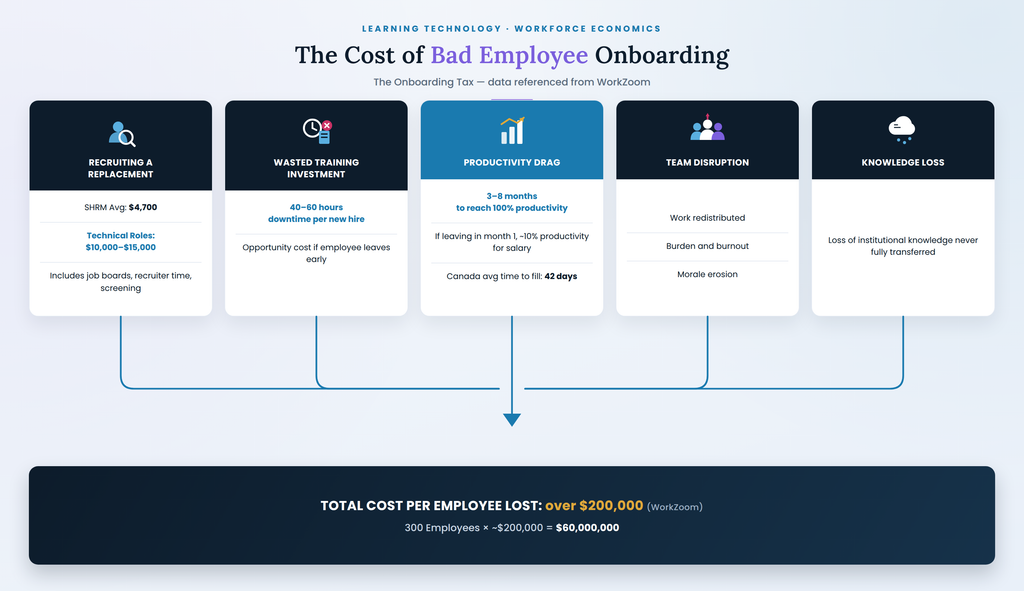
WorkZoom’s The Onboarding Tax framework highlights that the cost of employee turnover extends beyond recruitment. When an employee leaves, organizations incur costs in five key areas: recruiting a replacement, wasted training investment, productivity drag, team disruption, and knowledge loss.
Recruiting Replacement
That’s the direct cost for recruiting a new employee: job boards, recruiter time, background checks, interviews. SHRM’s benchmarking data puts the average cost per hire at $4,700. This cost range increases if the role you are looking for is more complex. For example for technical roles, the cost brackets get closer to $10,000-$15,000.
Training Waste
Training waste can be seen as the hours invested into the new hire. Every hour spent onboarding represents an investment that only generates value if the employee remains with the organization long enough to become productive. Workzoom averages that a new hire is allocated around 40-60 hours of downtime before any result is produced. So if a trainee leaves before the completion, then these hours are the opportunity cost for the organization.
Productivity drag
Although it is hard to measure productivity drag, it can be seen as the rate at which the employee increases its efficiency. On average an employee has a period of 3-8 months of productivity drag to 100%. So if the new employee leaves in the first month, you might gain 10% productivity for the salary paid. 10% because they were just starting to get a sense of what is expected and how to go about it. This does not take into account the average time to fill in the vacancy. For Canada, it’s 42 days on average and longer depending on the industry and role.
Team disruption
Team disruption is directly experienced at the team level. When a new team member leaves, then the work assigned to them gets redistributed among the team members. This in turn leads to more burden, burnout at a faster rate and more morale erosion.
Knowledge loss
This is the institutional knowledge lost that was transferred to the new hire.
This is all to say that there are real consequences for the organization when an employee leaves. If we were given a total figure for all these breakdown it could be from well over $200,000 per employee that is lost (WorkZoom). You can multiply that figure by your organization level turnover rate like 300 employees.
Where to start fixing your Onboarding issues
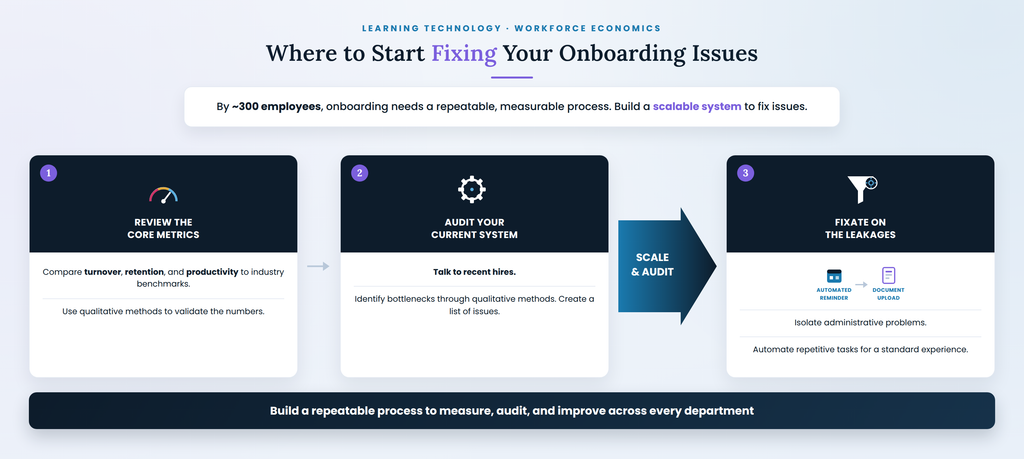
By the time an organization reaches roughly 300 employees, onboarding can no longer be managed through informal conversations or individual manager preferences. HR needs a repeatable process that can be measured, audited, and improved across every department. The goal is not simply to fix isolated issues but to build a system that scales as hiring continues.
Once you’ve identified the problem, it is time to start working to solve these issues. The following steps can taken:
Review the core metrics
Review the metrics like employee turnover, employee retention and productivity to assess your situation. Compare them to your competitors and industry benchmarks to check if you are underperforming or overachieving. If at these stage there are red flags then it is time to move into the next step
Audit your current system
It is time to audit your current systems. You can do this through qualitative methods like talking to recent employees about the problems they faced while onboarding and other questions. Try to make a list where the bottlenecks occurred for them and create possible solutions. For instance, if they failed to receive feedback from their manager, is there a backup in this case that the new hire can reach out to.
Fixate on the leakages
If the problems you are facing at the administrative level within the organization, you can isolate and automate these repetitive onboarding tasks to save time and give a standard experience. For example if a document is required after onboarding, an automated workflow can be created to remind the new hire to upload the document.
The positive impact of effective onboarding is well documented. BambooHR found that employees typically decide whether a new role is the right fit within the first 44 days, giving employers a relatively short window to create a positive onboarding experience.. Other studies also show that well-designed onboarding programs can increase employee retention by 52%, boost productivity by 60%, and improve job satisfaction by 53%. These findings highlight that onboarding isn’t just an HR task it’s imperative for strong business strategy. This is where WeCloudData’s Learning Management System (LMS) can make a difference. Instead of relying on manual processes and inconsistent training, organizations can automate compliance requirements, role-specific learning paths, onboarding milestones, and progress tracking all within one customizable platform.
Measuring the success of your onboarding program
A scalable onboarding process should be measured just like any other business function. Track a combination of operational metrics and employee outcomes to understand whether your onboarding is delivering results. There are many indicators to look at to assess the effectiveness of your application:
Employee retention
Are the employees staying beyond the probationary period? If yes then this has a positive impact on assessment and vice versa.
Employee satisfaction
Employee satisfaction means how satisfied are they with their team members, environment and the job that has been assigned to them.
Rate of completion of onboarding
Are the employees completing the mandatory training paths assigned to them? If not, it is time to identify the roadblockers and what could be improved.
Retention Threshold
A retention threshold in onboarding is a specific time checkpoint (most commonly 30, 60, or 90 days) used to measure if new hires or users successfully integrate into an organization or product.
Onboarding Satisfaction
Onboarding satisfaction is a measure of how well a new hire’s integration process is handled. It evaluates whether the introductory training, orientation, and initial resources provided by an organization make employees feel welcomed, prepared, and confident in their new roles from day one.
Fix your Onboarding with WeCloudData
A successful onboarding process doesn’t have to rely on manual checklists or guesswork. With WeCloudData’s Learning Management System (LMS), HR teams can make onboarding a seamless part of the employee journey through customizable learning paths and automated workflows. From compliance training and role-specific courses to onboarding milestones and reminders, the LMS handles the administrative heavy lifting while ensuring every new hire receives a consistent experience.
As organizations approach the 300-employee milestone, scalable onboarding becomes a competitive advantage rather than an administrative task. Instead of wondering whether employees are ready, managers can track completion rates, monitor progress through automated check-ins, and use real-time insights to confidently support every employee from day one. WeCloudData’s customizable LMS gives HR teams the tools to deliver that consistency at scale. Schedule a consultation call with WeCloudData’s team to discuss how you can improve your onboarding system today.
FAQs- Onboarding Process
Onboarding helps employees understand their role, company culture, and expectations. It improves confidence, productivity, and employee retention.
Bad onboarding is a disorganized process with poor communication and limited support, leaving employees confused, disengaged, and less productive.
Provide structured training, assign a mentor, communicate clear expectations, and conduct regular check-ins to support new employees.
Effective onboarding helps employees become productive faster, increases job satisfaction, and reduces mistakes through proper guidance and training.
WeCloudData’s LMS streamlines onboarding with customizable learning paths, automated compliance and role-specific training, milestone tracking, and completion metrics—helping HR replace guesswork with measurable employee progress.
Works Cited
AIHR. “27+ Employee Onboarding Statistics & Trends You Must Know in 2026.” AIHR, www.aihr.com/blog/employee-onboarding-statistics/. Accessed 20 Oct. 2026.
BambooHR. “First Impressions Are Everything: 44 Days to Make or Break a New Hire.” BambooHR, www.bamboohr.com/resources/data-at-work/data-stories/2023-onboarding-statistics. Accessed 20 Oct. 2026.
CodersLink. “Why You Should Spend Time on the Engineer’s Onboarding Process.” CodersLink, 14 Apr. 2026, coderslink.com/employers/blog/importance-of-the-engineer-onboarding-process. Accessed 20 Oct. 2026.
Gallup. “Essential Ingredients for an Effective Onboarding Program.” Gallup, 31 Jan. 2019, www.gallup.com/workplace/246242/essential-ingredients-effective-onboarding-program.aspx. Accessed 20 Oct. 2026.
HeyTeam. “Onboarding: Definition, Impacts and Implementation.” HeyTeam, 21 Aug. 2023, www.heyteam.com/blog-articles-en/onboarding-definition-impacts-and-implementation. Accessed 20 Oct. 2026.
JOIN. “Onboarding.” JOIN, 14 May 2026, join.com/en/glossary/onboarding. Accessed 20 Oct. 2026.
Navarra, Katie. “The Real Costs of Recruitment.” SHRM, 11 Apr. 2022, www.shrm.org/topics-tools/news/talent-acquisition/real-costs-recruitment. Accessed 20 Oct. 2026.
Qooper. “The Ultimate HR Onboarding Process: From Hire to High Performer.” Qooper, 19 Feb. 2026, www.qooper.io/blog/hr-onboarding-process. Accessed 20 Oct. 2026.
SHRM. “Average Cost per Hire Rises to $4,700, SHRM Survey Finds.” SHRM, www.shrm.org/topics-tools/news/talent-acquisition/average-cost-per-hire-rises-to-$4700-shrm-survey-finds. Accessed 20 Oct. 2026.
SW HR Consulting. “The Benefits of a Structured Employee Onboarding Process.” Medium, 10 Oct. 2023, medium.com/@swhrconsulting/the-benefits-of-a-structured-employee-onboarding-process-8bdf93bbe2cb. Accessed 20 Oct. 2026.
TechClass. “Creating Onboarding Programs for High-Volume Hiring Periods.” TechClass, 8 Aug. 2025, www.techclass.com/resources/learning-and-development-articles/creating-onboarding-programs-for-high-volume-hiring-periods. Accessed 20 Oct. 2026.
Woolley, Matthew. “Cost of Employee Turnover: Skip the Industry Average.” Workzoom, 9 Dec. 2025, updated 23 Aug. 2026, www.workzoom.com/blog/cost-of-bad-onboarding/. Accessed 20 Oct. 2026.
