Blog

Blog

Rise of the Data Generalist: Why Hybrid Skills Matter in Data Economy

January 22, 2026

For years, the data job market revolved around specialists: data analysts who wrote SQL all day, data engineers who built pipelines, and data scientists who focused on machine learning models. Today, that model is changing.

Organizations increasingly value professionals who can work across multiple stages of the data lifecycle—from extracting data to analyzing it, building basic models, and communicating insights to business teams. These professionals are known as data generalists, and their demand is rising rapidly.

This article explains what a data generalist is, why companies are hiring more hybrid data professionals, what skills they need, and how learners can prepare for this evolving role.

What Is a Data Generalist?

data generalist weclouddata.com

A data generalist is a data professional with working knowledge across analytics, engineering, and business problem-solving. Rather than specializing deeply in one narrow area, generalists operate across functions.

Typical responsibilities include:

  • Building dashboards or reports
  • Performing exploratory analysis
  • Understanding basic data modeling and pipelines
  • Translating business questions into analytical tasks

In practice, data generalists often act as the bridge between technical systems and business decision-makers.

Why Data Generalists Are on the Rise

Several industry shifts are currently accelerating the move toward hybrid data roles as companies increasingly prioritize agility and efficiency. Because startups and mid-sized organizations often cannot afford large teams of specialists, they are turning to generalists who can deliver high value across multiple domains. This transition is further supported by data platforms and AI-assisted analytics, which have reduced technical complexity and lowered the barrier to advanced modeling, making tasks that once required specialized engineering more accessible. Furthermore, the demand for faster business cycles means organizations can no longer afford the delays in hand-offs between siloed roles. Ultimately, the market is shifting toward professionals who can own the entire analytics workflow from start to finish rather than focusing on a single piece.

Core Skills of a Data Generalist

Data Analysis & Visualization

  • SQL for querying
  • Excel or spreadsheets
  • Power BI, Tableau, or similar tools
  • Data storytelling

Data Engineering Basics

  • ETL concepts
  • Data warehouses (BigQuery, Snowflake, Redshift)
  • Data modeling fundamentals

Programming & Automation

  • Python or R
  • Basic scripting and APIs
  • Introductory machine learning workflows

Business & Domain Knowledge

  • KPI design
  • Understanding revenue, cost, marketing, operations
  • Translating vague business questions into metrics

Communication Skills

  • Explaining results to non-technical stakeholders
  • Writing clear reports
  • Participating in strategic discussions

How AI Is Accelerating the Shift Toward Generalists

AI is reshaping how data work is done.

  • AutoML tools build models automatically
  • Natural language querying reduces SQL complexity
  • AI copilots generate code and documentation
  • Data quality checks are increasingly automated

These tools allow generalists to handle tasks that once required advanced specialization. While AI does not eliminate the need for expertise, it broadens what one person can realistically manage.

Use Cases Where Data Generalists Excel

Data generalists thrive in environments such as:

  • Startups with small analytics teams
  • Product analytics groups
  • Marketing and growth teams
  • Operations and logistics departments
  • Internal BI teams supporting leadership

These settings value adaptability over narrow depth.

Data Generalist Career Paths and Job Titles

Over time, many generalists as they get more skilled, they move into:

  • Analytics lead roles
  • Data product management
  • Strategy and operations leadership
  • Data platform ownership

Hybrid data roles that blend analytics, engineering, and business competencies are among the most actively recruited positions as organizations seek professionals who can manage the full data lifecycle. In a recent job posting analysis covering data and analytics roles, generalist-oriented listings (such as analysts who can handle multiple tools and workflows) accounted for a large share of openings analysts alone made up roughly 69% of over 75,000 indexed data vacancies on major job platforms, far exceeding roles focused on single specialties like data engineering or data science.

Industry forecasting also shows that employment for data-related roles including those requiring hybrid skill sets is projected to expand much faster than average. One employment outlook suggests data and analytics roles may grow by about 34% between 2024 and 2034.

Challenges of Being a Data Generalist

Despite the benefits, the role has limitations:

  • Risk of shallow expertise in advanced domains
  • Continuous learning pressure
  • Ambiguous job titles
  • Harder positioning in highly specialized teams

Successful generalists manage this by building strong fundamentals and selectively deepening one or two focus areas over time.

Learning Data Skills with WeCloudData

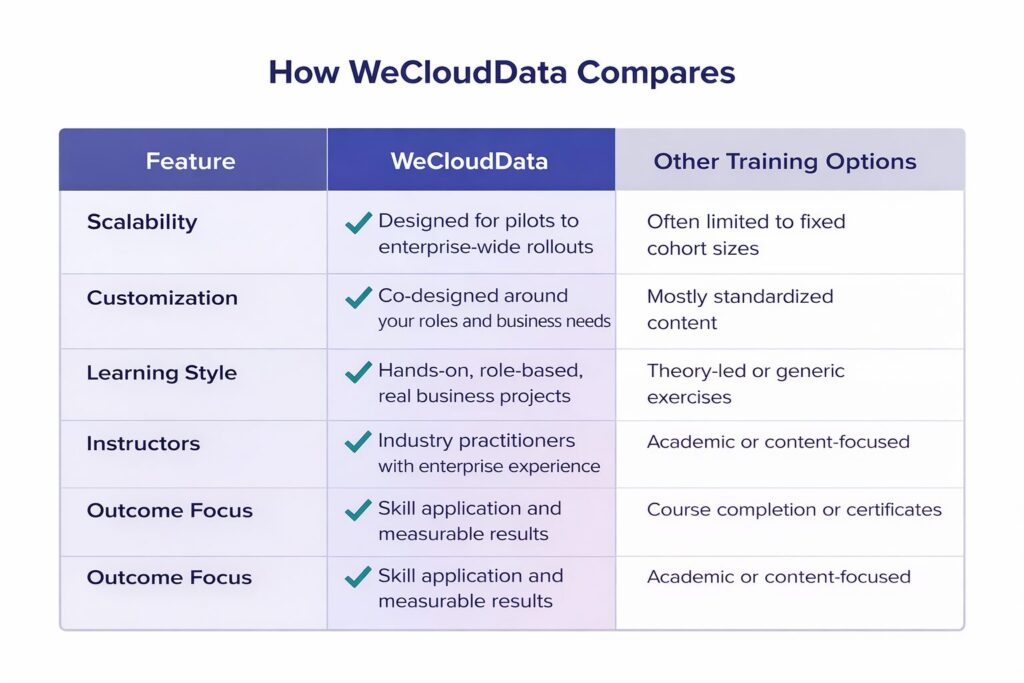
WeCloudData’s training programs are designed around the same hybrid skill model employers expect from modern data professionals.

Across its data analytics, data engineering, and AI tracks, learners develop:

Rather than training students for a single narrow role, WeCloudData emphasizes end-to-end problem solving, helping graduates operate as effective data generalists in real organizational environments.

FAQs – Data Generalists

What is a data generalist?

A professional who works across analytics, engineering, and business problem-solving rather than specializing in one narrow domain.

Are data generalists in demand?
Yes. Hybrid roles dominate job listings, especially in startups and product-driven organizations.

Is a data generalist better than a data scientist?
Neither is better universally. Generalists suit operational analytics; data scientists suit advanced modeling and research.

Can beginners become data generalists?
Yes. Many start as analysts and gradually expand into engineering and modeling tasks.

SPEAK TO OUR ADVISOR
Join our programs and advance your career in GenAI

"*" indicates required fields

This field is for validation purposes and should be left unchanged.
Name*
Other blogs you might like
Student Blog
The blog is posted by WeCloudData’s Bid Data course student Udayan Maurya. Customer reviews are invaluable information to understand the…
by Student WeCloudData
May 28, 2020
Blog, Learning Guide
Property management includes many tasks, like maintenance requests, scheduling repairs, sending payment reminders, and tracking reports. It’s a constant…
by Maliha
August 18, 2025
Consulting
Background Our client is a company manufacturing consumer electronic products like mobile devices, printers, computer monitors and so on,…
by Beam Data
October 19, 2021

Kick start your career transformation