
Key Takeaways
- Building an AI-ready workforce requires more than generic AI training—it requires a structured capability development strategy.
- Start by assessing current AI skills, then create role-based learning pathways aligned with real business needs.
- Measure capability growth through skill improvement, adoption, and business impact—not just course completions.
- Scaling AI adoption requires the right platform, content, and visibility across the organisation.
- WeCloudData LMS helps organisations build, deliver, and track AI capability programmes at enterprise scale.
Build an AI Ready Workforce?
The email lands in your inbox on a Tuesday morning. Subject line: Strategic Priority: AI Transformation.
Your CEO has just announced that artificial intelligence is now the company’s defining operational pillar. Everyone in the executive steering meeting nods along. Then, inevitably, all eyes turn toward the Learning & Development and HR teams. The expectation sounds incredibly simple: “Go build an AI-ready workforce.”
While the request appears straightforward, most L&D leaders quickly encounter identical, frustrating obstacles:
- No enterprise-wide system exists for developing and scaling AI capability.
- No structured learning pathways are tailored to what different roles actually do all day.
- No reliable tracking exists to measure workforce readiness beyond shallow completions.
- Available content is trapped in basic, superficial introductory AI courses.
This isn’t just an internal friction point; it’s a global corporate phenomenon. According to the Microsoft Work Trend Index, a striking 75% of knowledge workers already use AI at work. However, the vast majority are doing so using their own “shadow IT” methods, completely starved of formal organizational support or structured training.
The core challenge isn’t finding more AI courses. It’s building a repeatable system that develops an integrated AI workforce development plan and provides measurable evidence of progress. If you are leading L&D, People, or Operations teams at a 300–1,000 person organization, here is how you build that operating system.
Why Most AI Workforce Initiatives Stall
Despite strong executive backing, the vast majority of enterprise AI training initiatives lose momentum within the first 90 days. If you want to avoid the common traps, you need to understand where the gears grind to a halt.
Executive Commitment Doesn’t Automatically Build Capability
Many CEOs recognize AI as a critical strategic priority. However, the execution path for workforce capability almost always becomes fragmented across organizational silos:
- Executive Leadership owns the high-level strategy and vision.
- IT and Security Teams govern technology access, API pipelines, and data privacy.
- Business Unit Leaders pursue immediate, short-term team productivity.
- L&D is handed the keys and expected to somehow magically enable workforce adoption.
Without a shared operating model connecting these individual silos, implementation completely stalls out. This disconnect is explicitly highlighted in the PwC Global CEO Survey, which consistently notes that while AI and workforce transformation dominate executive agendas, pervasive capability and skills shortages remain the definitive barriers to actual value creation.
Generic AI Training Doesn’t Create Capability
Most organizations check the compliance box by rolling out a generic training suite. They open up access to standard AI awareness sessions, a quick prompt engineering webinar, or basic ChatGPT demonstrations.
These tools marginally improve awareness, but they leave employees staring at a blinking prompt line, unable to answer practical, job-critical questions:
- How should I safely use generative AI within my specific role?
- Which corporate tools are actually approved for customer data?
- What does “proficient” or “good” AI utilization look like in my department?
When learning remains fundamentally disconnected from daily, localized work, employee behavior doesn’t change.
Organizations Measure Activity Instead of Capability
Eventually, leadership asks the ultimate question: “Is our workforce actually becoming more AI capable?”
Most organizations can only export spreadsheets showing vanity metrics: course completions, attendance logs, and digital certificates earned. These parameters describe learning activity—not organizational AI readiness.
To break this cycle, AI capability must be managed as a strategic business asset, not simply another content-consumption initiative.
A Practical AI Workforce Development Framework
To build sustainable AI capability in your team, you need to shift away from ad-hoc training sessions and adopt a continuous, five-stage loop: Assess -> Segment -> Learn -> Apply -> Measure. Each step directly builds on the foundation of the previous one.
Step 1: Assess Current AI Capability
Before assigning a single piece of learning content, establish an organizational baseline. Running a comprehensive AI skills assessment allows you to map existing capabilities across five core areas:
- AI Literacy: Understanding fundamental AI concepts, capabilities, and cognitive limitations.
- Confidence: Individual comfort levels when interacting with conversational user interfaces.
- Tool Familiarity: True competence across enterprise-approved platforms.
- Workflow Adoption: The frequency and depth of integrating AI into current daily tasks.
- Governance Awareness: Deep alignment with corporate data privacy frameworks and security boundaries.
This initial diagnostic step is more critical than ever. The World Economic Forum’s Future of Jobs Report explicitly identifies analytical thinking, AI literacy, and technical skills among the fastest-growing global workforce capabilities. You cannot fix a skills gap until you map exactly where it lives.
Step 2: Build Role-Based Learning Pathways
A one-size-fits-all approach fails completely here. Different business functions require entirely distinct AI capability frameworks because their core operational problems are entirely different.
- Marketing: Focuses on brand-safe prompting, rapid content generation, campaign ideation, and deep audience research.
- Sales: Prioritizes localized account research, proposal drafting, and automated CRM productivity workflows.
- Human Resources: Centers on policy creation assistance, interview preparation frameworks, and scaling employee communications.
- Finance: Emphasizes specialized spreadsheet analysis, reporting summaries, automated script building, and document parsing.
- Managers: Focuses intensely on AI leadership, operational governance, and coaching teams through AI adoption curves.
Role-specific learning dramatically improves cognitive relevance, increases immediate engagement, and accelerates real workforce adoption compared to generic enterprise courses.
Step 3: Integrate Learning Into Everyday Work
Capability develops through active execution, not passive video consumption. Research from the Association for Talent Development (ATD) and modern corporate learning theories consistently demonstrate that learning embedded directly within day-to-day work produces significantly stronger capability development than standalone training events.
High-impact programs combine micro-learning modules with practical, hands-on application:
- Deliver Micro-Learning: Under 10 minutes.
Break concepts down into bite-sized, accessible explainers that don’t disrupt the workday. - Issue a Workflow Challenge: Immediate application.
Require the employee to complete an immediate, real-world task using an AI tool within 48 hours. - Deploy Functional Templates: Lowering the barrier to entry.
Provide pre-built prompt libraries and department-specific templates directly inside their workspace. - Facilitate Peer Sharing Loops: Social proof.
Host brief weekly syncs where team members showcase specific AI use cases that successfully saved them time.
Step 4: Measure Capability Growth
It’s time to swap out legacy training metrics for data that your executive board actually cares about. Shift your reporting dashboard into three clear tiers:
| Metric Category | What You Are Actually Measuring | Examples |
| 1. Learning Metrics | Basic program engagement | Completion rates, participation logs, modules viewed |
| 2. Capability Metrics | Measurable skill progression | Pre- vs. post-assessment scores, confidence growth, verified use-case application |
| 3. Business Metrics | Actual operational impact | Self-reported time saved per week, core tool adoption rates, manager-tracked workflow improvements |
What an AI Capability Programme Looks Like in Practice
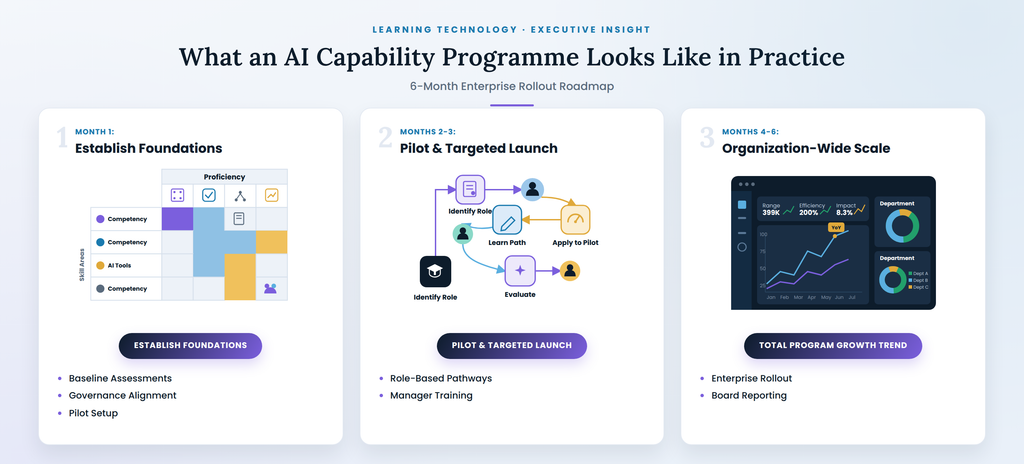
What does a structured rollout look like for a 500-person organization over a typical business half-year?
Month 1: Establish Foundations (Weeks 1–4)
Conduct organization-wide baseline capability assessments. Align executive leadership on data security and tool governance rules. Prioritize high-impact business functions (e.g., Marketing and Sales) for the initial pilot phase.
Months 2–3: Pilot & Targeted Launch (Weeks 5–12)
Deploy tailored, role-based learning pathways for pilot groups. Launch specialized AI leadership training paths for managers to oversee governance. Gather initial workflow optimization feedback and refine department templates.
Months 4–6: Organization-Wide Scale (Weeks 13–24)
Scale targeted learning pathways across all remaining corporate departments. Track skill development, tool adoption, and confidence shifts on a centralized HR dashboard. Present concrete time-saved and capability growth reports to the executive board.
Three Essential Components of Every Successful Programme
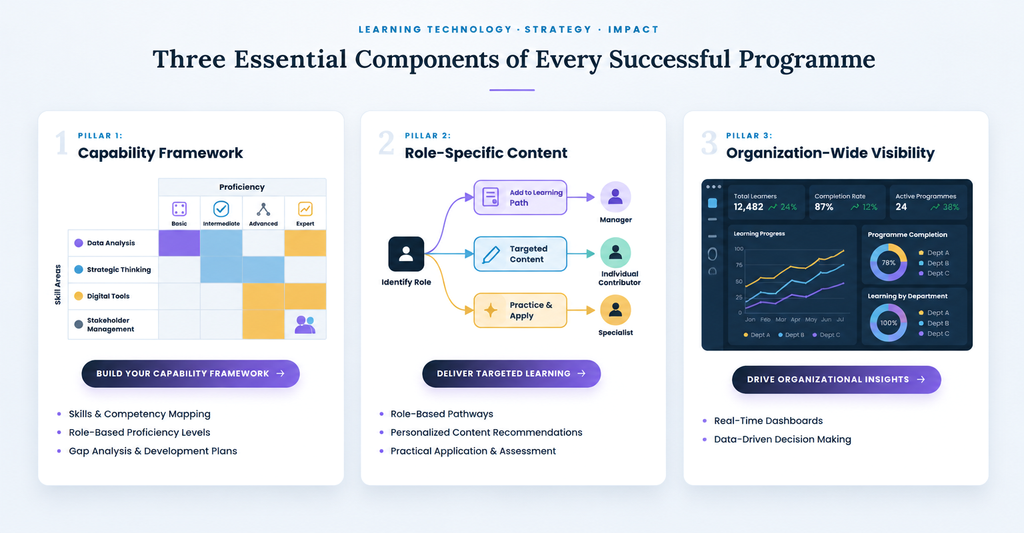
If you want your enterprise AI training strategy to stick long-term, make sure these three operational pillars are firmly established:
- A Clearly Defined Capability Framework: You must explicitly define what “proficient” looks like for an account executive versus an accountant, mapping out a transparent path for skill progression.
- High-Quality, Role-Specific Content: Avoid dry, theoretical AI lectures. Employees need actionable, contextual content that solves real, day-to-day workplace problems.
- Organization-Wide Visibility: Leadership shouldn’t be left guessing. You need automated dashboards that show real-time capability metrics by department, engagement levels by role, and remaining skill gaps.
Where Most L&D Teams Get Stuck
When these programs stall out, it is rarely due to a lack of vision or strategy. It is almost always an infrastructure problem.
Data from the IBM Global AI Adoption Index consistently shows that limited AI expertise and deep skills shortages remain the most significant barriers preventing organizations from scaling AI successfully. For an L&D team, this manifests as immense operational friction.
Teams frequently find themselves bogged down trying to build custom AI training content from scratch, manually updating messy tracking spreadsheets across hundreds of employees, and attempting to stitch together basic charts for executive reporting. This overwhelming manual overhead leaves zero room to actually coach teams or drive cultural change.
How WeCloudData LMS Enables AI Capability Development
Building an AI-ready workforce requires more than access to training content. Organisations need a structured system that connects capability assessment, role-based learning, content delivery, and measurable progress.
WeCloudData LMS provides the foundation L&D teams need to operationalise AI workforce development at scale. The same platform architecture already supports enterprise deployments spanning 35 business units with a 4.8 out of 5 satisfaction rating, and has been performance-tested at 10,000 concurrent users, sub-400ms response times, and under 0.1% error rate — so it holds up as AI programmes scale from a pilot group to the full organisation, without the slowdowns or breakage that come from stitching together spreadsheets and disconnected tools.
Instead of managing disconnected tools, spreadsheets, and standalone courses, organisations can use WeCloudData LMS to create a centralised AI capability programme that enables them to:
- Assess AI capability across roles and teams to identify current skill levels and development gaps.
- Deliver curated AI learning pathways aligned with specific job functions, ensuring employees receive relevant training for their daily workflows.
- Access a curated catalogue of AI learning content designed to move employees beyond basic awareness into practical application.
- Track workforce progress and engagement through centralised reporting and analytics.
- Demonstrate measurable capability growth with clear visibility for HR leaders, L&D teams, and executives.
With WeCloudData LMS, organisations can transform AI adoption from an informal experimentation process into a structured, measurable workforce capability strategy.
The goal is not simply to train employees on AI tools — it is to build a workforce that can confidently apply AI to improve productivity, decision-making, and business outcomes.
If your organisation is ready to move past ad-hoc AI training toward a structured, measurable capability programme, schedule a consultation with the WeCloudData team to see how the platform can support your rollout — from initial baseline assessment through organisation-wide scale.
Frequently Asked Questions (FAQ)
Building AI capability requires more than generic training. Organisations need assessments, role-based learning pathways, practical application, and measurable progress tracking.
An AI workforce development plan is a structured approach to assessing, developing, and measuring AI skills across an organisation based on employee roles and business needs.
AI readiness is measured through capability assessments, learning engagement, tool adoption, confidence improvements, and demonstrated workplace application.
Role-based AI training should focus on practical use cases relevant to each function, such as AI-assisted research for sales or workflow automation for finance teams.
Most AI programmes fail because they rely on generic content without role relevance, capability tracking, or a system to measure long-term adoption.
WeCloudData LMS helps organisations assess AI capability, deliver curated learning pathways, track progress, and manage AI workforce development from one central platform.
Works Cited
Association for Talent Development. Association for Talent Development. https://www.td.org/. Accessed 28 Oct. 2026.
IBM. “AI Adoption.” IBM, https://www.ibm.com/reports/ai-adoption. Accessed 28 Oct. 2026.
Josh Bersin. Josh Bersin. https://joshbersin.com/. Accessed 28 Oct. 2026.
McKinsey & Company. “The State of AI.” McKinsey & Company, https://www.mckinsey.com/capabilities/quantumblack/our-insights/the-state-of-ai. Accessed 28 Oct. 2026.
Microsoft. “AI at Work Is Here. Now Comes the Hard Part.” WorkLab, 8 May 2024, https://www.microsoft.com/en-us/worklab/work-trend-index/ai-at-work-is-here-now-comes-the-hard-part.
PwC. “CEO Survey.” PwC, https://www.pwc.com/gx/en/issues/c-suite-insights/ceo-survey.html. Accessed 28 Oct. 2026.
World Economic Forum. The Future of Jobs Report 2025. World Economic Forum, 2025, https://www.weforum.org/reports/the-future-of-jobs-report-2025/.
