
Key Takeaways
- L&D leaders are often spending too much time managing administration instead of building workforce capability.
- Manual tracking, reporting, and follow-ups limit the strategic impact of L&D teams.
- Automation removes operational friction and allows L&D professionals to focus on business-critical priorities.
- Modern LMS platforms should provide analytics, automation, and visibility.
- WeCloudData LMS helps L&D leaders move from administrative management to strategic capability building.
How L&D Became an Administration Function
An enterprise hires a Director of Learning & Development (L&D). They bring a master’s degree, 15 years of organizational development expertise, and a clear executive mandate: prepare the enterprise workforce for rapid digital transformation, AI integration, and shifting market demands.
Six months into the role, a stark reality sets in.
Instead of spending their time designing workforce capability models or advising executives on technical skill roadmaps, many L&D leaders find themselves consumed by operational tasks—troubleshooting learning systems, reconciling spreadsheets, chasing compliance inputs, and producing reporting decks dominated by activity metrics rather than business outcomes.
The irony of the corporate L&D function is striking: the exact department tasked with building organizational leverage, productivity, and capability across the enterprise is often one of the most manually operated, admin-heavy units in the company.
L&D leaders do not lack vision, ambition, or strategic acumen. They are trapped by legacy software architectures that force them to operate as system administrators rather than strategic architects.
The “LMS Janitor” Trap
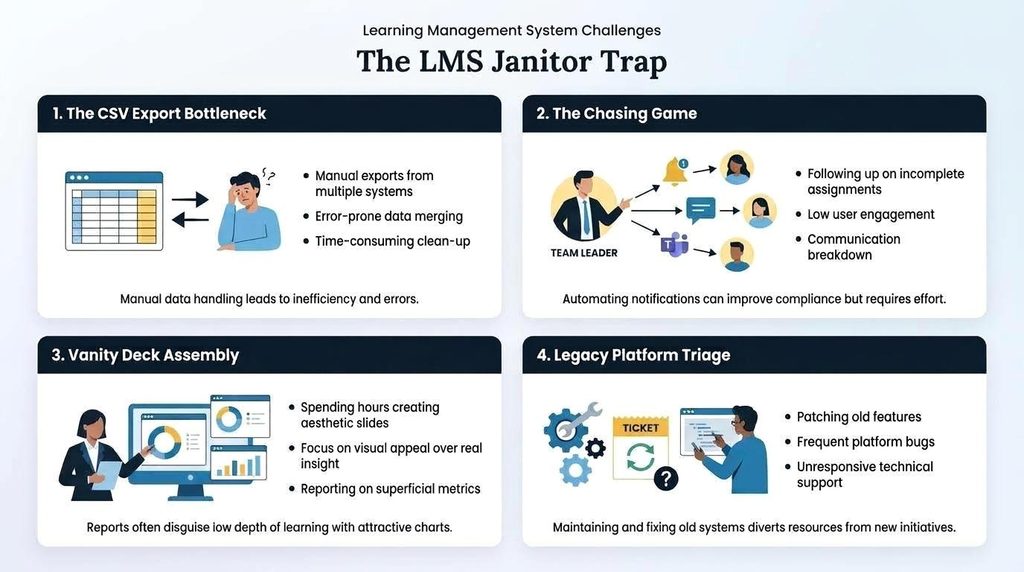
In many organizations, the daily schedule of an L&D Director looks less like strategic workforce planning and more like low-level IT triage. The administrative drag manifests across four primary operational bottlenecks:
1. The CSV Export Bottleneck
Because legacy platforms lack flexible, role-based reporting, L&D leaders act as human data conduits. When a VP of Engineering asks who on their team is certified in cloud security, the L&D Director must manually extract, filter, format, and email a spreadsheet.
2. The Chasing Game
A significant portion of L&D bandwidth is consumed by manual follow-ups: issuing compliance reminders, tracking down missing assignment sign-offs, and emailing line managers about overdue direct reports.
3. Vanity Deck Assembly
At the end of every quarter, L&D teams spend days compiling presentation decks filled with completion statistics such as total course logins and hours watched to present to HR leadership.
4. Legacy Platform Triage
Managing outdated software configurations, credential resets, and course assignment bugs turns strategic leaders into technical support agents.
The Hidden Organizational Costs of Admin-Heavy L&D
Treating L&D as a compliance logging center inflicts severe operational costs across the enterprise:
- Loss of C-Suite Credibility: When L&D presents activity metrics (hours watched) instead of capability metrics (project execution speed or verified skills), executive leadership views L&D as an cost center rather than a business growth driver. Industry analyses from The Josh Bersin Company emphasize that L&D must shift from measuring “learning activity” to “business capability” to maintain executive alignment.
- Slow Organizational Adaptation: In fast-moving technical domains, taking months to manually deploy and track a course means the skills are outdated by the time the rollout finishes.
- Talent Burnout & Turnover: Top talent development strategists do not stay in roles where their primary output is spreadsheet maintenance. This friction leads to high cost in L&D leadership.
- Unlinked Business Outcomes: Deloitte research highlights that many organizations struggle to connect workforce development efforts with measurable business outcomes, emphasizing the need to align skills, learning, and talent strategies with evolving business priorities.
Reclaiming the Role: What Changes When You Automate?
Not every part of learning operations requires human intervention. The goal of automation is not to remove the human element from learning, but to eliminate the administrative layer that prevents L&D professionals from driving higher-value initiatives.
When you shift from a legacy, administrative model to an automated, strategic framework, the transformation across the enterprise is profound:
| Operational Focus | The Administrative L&D Director (Legacy) | The Strategic L&D Architect (Automated) |
| Data & Reporting | Manually compiles and formats monthly spreadsheets. | Live, self-serve dashboards give department heads real-time access. |
| Skill Assessment | Relies on annual self-assessments and completion forms. | Evaluates real-time practical outputs from hands-on sandboxes. |
| Stakeholder Syncs | Defends training budgets using hours-logged metrics. | Demonstrates business ROI, project speed, and capability readiness. |
| Workflow Triggers | Sends manual follow-up emails for missed deadlines. | Automated escalation alerts notify managers automatically. |
| Core Priority | Managing course catalogs and platform uptime. | Aligning workforce capabilities with 12-month business roadmaps. |
From System Administrator to Capability Architect
By automating operational processes, L&D leaders can fundamentally rewrite their relationship with the organization:
- From Training Coordinator to Capability Architect: Instead of scheduling programs, managing enrollments, and tracking completion, L&D leaders shift toward identifying capability gaps, designing workforce development strategies, and aligning learning directly with business priorities.
- From Reporting Activity to Providing Intelligence: Completion reports answer, “Did employees finish training?” Capability dashboards answer, “Are our people developing the skills the organization needs?” This shift elevates conversations with leadership to focus on workforce readiness, emerging skill gaps, and business execution.
- From Order-Taker to Strategic Partner: Admin-heavy L&D is reactive, taking requests like “Can you organize this training?” Strategic L&D prompts executives to ask, “How do we prepare our team for what comes next?”
The 3 Architectural Shifts Required for Strategic Focus
To transition out of administrative maintenance, organizations must execute three core operational shifts:
- Decouple Reporting via Self-Serve Portals: Department managers—not L&D directors—are responsible for the daily performance of their teams. Providing line managers with direct, self-serve access to live training progress eliminates L&D as a report-generating bottleneck.
- Automate Nudges and Escalation Pipelines: System-generated alerts should handle deadline reminders, assignment pushes, and onboarding sequences automatically through tools like Slack, Teams, or automatic email.
- Move from Completion Metrics to Practical Telemetry: Tracking video completion rates provides zero proof of capability. Organizations must transition to practical assessments such as hands-on practice that evaluate whether an employee can perform the task on the job. Insights from LinkedIn Learning’s Workplace Learning Reports consistently highlight that hands-on, practical skill application is the primary predictor of successful upskilling.
How Modern Platforms Liberate L&D Leaders
Modern learning platforms like WeCloudData LMS eliminate administrative friction by redesigning the underlying software architecture:
- Self-Serve Manager Portals: Give department heads instant visibility into team progress, assessment scores, and skill gaps without requesting manual HR reports.
- Automated Escalation Workflows: Manage deadline reminders, compliance tracking, and recertification schedules automatically behind the scenes.
- Strategic Capability Analytics: Transform raw learning data into executive dashboards, allowing L&D Directors to present clear capability benchmarks directly to the C-suite.
When organizations eliminate the administrative drag of manual reporting and legacy platform maintenance, L&D stops functioning as an cost center and steps into its true role: a primary driver of enterprise growth and competitive capability.
Free Your L&D Team from Administrative Drag
Ready to automate manual spreadsheet reporting and equip your leadership team with real-time capability insights? Explore how WeCloudData’s enterprise learning platform frees L&D Directors to focus on strategy. Book a demo today.
Frequently Asked Questions (FAQ)
Most legacy enterprise software was designed for HR compliance auditing rather than enablement. As a result, L&D teams are forced to act as manual bridges—extracting data, creating custom reports, and issuing training reminders that modern platforms handle automatically.
When administrative overhead is automated, L&D leaders reallocate their bandwidth toward strategic initiatives: mapping skills to technical roadmaps, designing targeted cohort programs, and working directly with department heads to close execution gaps.
Vanity metrics track passive activity (video watch time, course, rates). Capability metrics measure active application and business impact (practical task cycle time reduction, pre- and post-assessment performance, practical sandbox scores, and project execution quality).
No. An LMS supports L&D teams by removing administrative workload and improving visibility. Human expertise remains essential for strategy, programme design, and organisational change.
WeCloudData LMS provides automation, analytics, learning pathways, and workforce visibility so L&D teams can spend less time managing processes and more time developing organisational capability.
Works Cited
Bersin, Josh. “The Rise of Capability Academies.” Josh Bersin, Feb. 2023, joshbersin.com/2023/02/the-rise-of-capability-academies/. Accessed 16 Nov. 2026. (Note: Check the exact day of publication on the page if visible—e.g., “14 Feb. 2023″—as the article could not be loaded directly).
“Learning Systems Comparison.” Fosway Group, 23 Mar. 2026, www.fosway.com/research/learning-systems/. Accessed 16 Nov. 2026.
Poynton, Shannon, et al. “2026 Global Human Capital Trends.” Deloitte Insights, 4 Mar. 2026, www.deloitte.com/us/en/insights/topics/talent/human-capital-trends.html. Accessed 16 Nov. 2026.
“2026 Global Human Capital Trends.” Deloitte, 2026, www.deloitte.com/global/en/our-work/insights/topics/talent/human-capital-trends.html. Accessed 16 Nov. 2026. (Note: This URL points to the global edition of the same Deloitte report listed above; if both pages display the same text, you only need to cite the one you actually used).
“Workplace Learning Report 2025.” LinkedIn Learning, 2025, business.linkedin.com/learn/resources/workplace-learning-report. Accessed 16 Nov. 2026.
