
Agriculture is entering a new technological era. As global populations grow and global foodwater scarcity intensifies, traditional farming methods alone can no longer sustain rising food production demands while minimizing environmental impact.
Artificial intelligence is emerging as a critical solution — helping farmers, agribusinesses, and policymakers make smarter, faster, and more sustainable decisions. From predicting crop yield to optimizing supply chains, modern AI systems are changing how agriculture operates in real time.
This article explores how AI is transforming agriculture and why developing AI skills for agriculture professionals is becoming essential — culminating in how structured training programs can prepare the workforce for this shift.
The Growing Need for AI in Agriculture
Agriculture faces simultaneous pressures:
- Climate variability affecting weather data reliability
- Soil degradation impacting soil health
- Labor shortages
- Increasing demand for higher agricultural productivity
- The need for sustainability and reduced waste
Traditional decision-making based on historical experience is no longer sufficient. Today, agriculture data analytics and intelligent automation allow stakeholders to respond to changing conditions.
AI enables farms to move from reactive to predictive operations through advanced ai models powered by large-scale datasets.
Core Technologies Driving Modern Agriculture
Machine Learning in Farming
Machine learning in farming allows systems to analyze historical and live data to detect patterns humans cannot easily see. These systems help predict yields, planting schedules, and recommend fertilizer use based on soil conditions and climate trends.
Examples include:
- Forecasting crop performance using satellite imagery
- Predicting irrigation needs
- Detecting early risks from pests and diseases
Natural Language Processing in Agriculture
Natural language processing helps farmers and analysts extract insights from research papers, extension reports, and market updates. AI tools can summarize agronomic studies, interpret regulations, and provide conversational decision support systems accessible even to non-technical users.
Real-Time Intelligence and AI-Enabled Operations
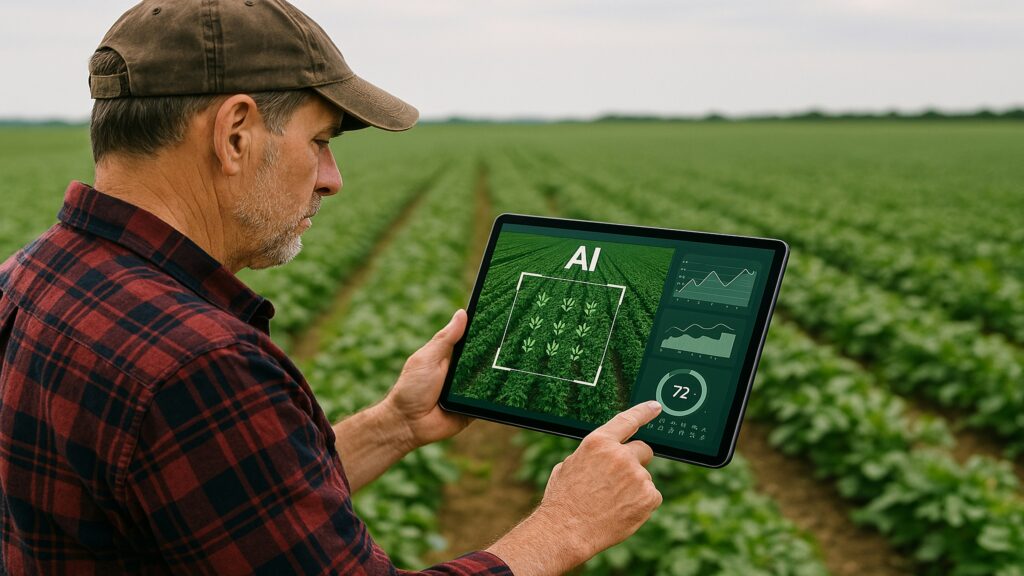
Modern farms increasingly rely on real time analytics. Sensors continuously monitor moisture, temperature, and nutrient levels, feeding data into AI enabled platforms that automatically recommend actions.
These systems help:
- Improve irrigation efficiency
- Reduce chemical overuse
- Support reducing waste
- Optimize harvesting and logistics
Real Industry Applications and Impact
1. Yield Prediction and Planning
AI systems analyze weather data, historical production, and soil metrics to predict crop yield with high accuracy. This improves planting strategies and reduces financial risk.
2. Disease and Pest Detection
Image-based models identify early-stage infections, intervention before widespread crop loss.
3. Soil Optimization
AI evaluates soil conditions and nutrient patterns, improving long-term soil health and reducing environmental damage.
4. Smarter Supply Chains
Predictive analytics help predict demand, optimize storage, and prevent spoilage — significantly reducing waste across agricultural supply chains.
5. Support for Developing Regions
AI-powered mobile tools give smallholder farmers access to advisory insights previously limited to large operations, improving agricultural productivity globally.
Why AgriBusiness needs AI teams
The expansion of AI adoption is creating demand for professionals who understand both farming operations and advanced analytics.
Organizations increasingly need:
- Agronomists who understand machine learning
- Analysts skilled in agriculture data analytics
- Technical specialists collaborating with AI developers
- Decision-makers capable of interpreting AI outputs
This skills gap highlights the importance of learning pathways tailored to agriculture professionals.
Learn AI for Agriculture & Sustainability Training by WeCloudData
The AI for Agriculture training program by WeCloudData is designed to bridge agriculture expertise with applied AI capabilities.
The program is suitable for agribusiness professionals, analysts, researchers, and aspiring AI practitioners seeking to specialize in agriculture-focused solutions. Designed for non-technical professionals, WeCloudData’s AI for Agriculture and Food Security empowers agronomists, farm managers, and policy officers to build and deploy practical, no-code AI automation workflows such as automated pest alerts or AI-summarized soil reports—using tools like ChatGPT and Gemini. By emphasizing productivity, sustainability, and responsible AI use, learners gain the actionable skills to unify fragmented data silos into daily, profit-driving decisions.
Frequently Asked Questions (FAQ)
1. How is AI used in the agriculture industry?
AI supports multiple stages of farming, including planting optimization, pest detection, irrigation management, logistics planning, and sustainability monitoring. It enables real-time decision-making that improves efficiency and reduces environmental impact.
2. What is artificial intelligence’s application in agriculture?
Artificial intelligence applications include precision farming, crop monitoring, predictive analytics, supply chain optimization, and smart systems for farmers and agricultural organizations..
3. How does AI help with global food and water scarcity?
Efficiency is the only way to solve it. By using agriculture analytics, we can produce more food using 30% less water and fewer chemicals. AI identifies exactly where resources are needed, reducing waste and lowering the environmental impact of food production.
4. Can AI actually help smallholder farmers?
Yes. Through natural language processing, AI can translate complex data into simple voice memos in local dialects. This gives smallholder farmers access to the same level of decision support as industrial farms, helping them improve their agricultural productivity.
5. What makes WeCloudData’s training different from a generic AI course?
It is 100% focused on the agricultural value chain. You will learn the fundamentals to creating your own automation project where you build a tool specifically for Ag-sector challenges
6: Is there corporate training available for my entire team?
Absolutely. WeCloudData offers customized corporate workshops that use your farm’s actual data to build projects during the training.
