
Data is abundant, but good decisions are not automatic. Organizations increasingly recognize that analytics alone is insufficient—they need structured methods to turn insights into action. This is where decision science and AI intersect.
Decision science provides the framework for making optimal choices under uncertainty. Artificial intelligence (AI) supplies the scale, speed, and predictive power to execute those choices in complex, real-world environments. Together, they form the backbone of modern, data-driven organizations.
What Is Decision Science? (Quick Definition)
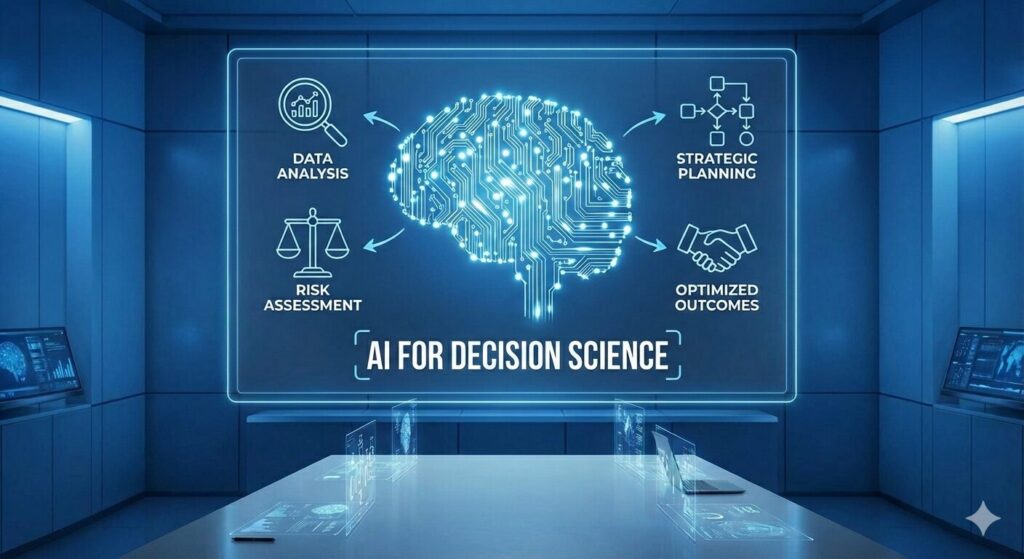
Decision science is the discipline of using data, statistical models, optimization techniques, and business rules to determine the best possible action among alternatives.
Instead of asking “What happened?” or “What might happen?”decision science asks: “What should we do next?”
AI enhances this process by automating analysis, learning from outcomes, and continuously improving recommendations.
How AI Enhances Decision Science
AI strengthens decision science in four major ways:
1. Large-Scale Data Processing
AI systems analyze massive volumes of structured and unstructured data (transactions, text, sensor data, logs) far beyond human capacity.
2. Predictive Modeling
Machine learning models forecast demand, risk, churn, fraud, and system failures—key inputs for decision optimization.
3. Optimization and Automation
AI enables real-time decision engines that recommend or execute actions automatically (pricing changes, inventory rebalancing, credit approvals).
4. Continuous Learning
AI models improve as new data becomes available, refining decisions over time through feedback loops.
What AI-Driven Decision Science Looks Like in Practice
Here are common enterprise applications:
Healthcare – Treatment recommendations based on patient risk profiles and historical outcomes
Finance – Credit scoring, fraud detection, portfolio optimization
Retail – Dynamic pricing, inventory placement, promotion targeting
Supply Chain – Demand forecasting, routing optimization, production scheduling
Marketing – Customer segmentation and personalized offers
These systems combine predictive models with decision rules to move from insight to action.
Decision Intelligence: The AI-Powered Evolution
Many organizations now refer to this field as decision intelligence—the operationalization of decision science using AI, analytics, and automation.
Decision intelligence platforms integrate:
- Data pipelines
- Machine learning models
- Optimization logic
- Business constraints
- Monitoring and feedback systems
The result is repeatable, auditable, scalable decision-making.
Components of AI-Enabled Decision Science
Data Engineering & Preparation
Clean, governed, timely data inputs
Machine Learning Models
Forecasting and classification algorithms
Optimization Engines
Mathematical models that evaluate trade-offs
Explainability Layers
So business leaders can trust and validate AI recommendations
Human Oversight
Humans remain responsible for high-risk or strategic decisions
Ethical and Practical Considerations
AI-driven decisions introduce new responsibilities:
- Bias control – Models can inherit biased data
- Transparency – Black-box decisions reduce trust
- Data privacy – Sensitive inputs require governance
- Human accountability – AI supports decisions; it does not replace responsibility
Well-designed decision systems incorporate ethics, governance, and explainability from the start.
Decision Science and AI in the Enterprise
Organizations adopting AI-driven decision systems report improvements in:
- Operational efficiency
- Cost control
- Forecast accuracy
- Risk reduction
- Customer experience consistency
However, success depends less on tools and more on skills: teams must understand modeling, business context, and implementation.
How to Start Combining AI with Decision Science
A practical roadmap:
- Identify high-impact decisions (pricing, hiring, fraud, logistics)
- Ensure reliable data pipelines
- Start with decision support (recommendations) before full automation
- Build cross-functional teams (data + business + operations)
- Implement governance and performance monitoring
Learning Decision Science and AI with WeCloudData
At WeCloudData, decision science is taught as an applied discipline—not just a theoretical one.
WeCloudData training programs integrate:
- Data science and machine learning foundations
- Optimization and analytics workflows
- Cloud-based AI deployment
- Real-world business decision scenarios
Through hands-on projects, learners build decision models that mirror production environments combining predictive analytics, business constraints, and operational execution.
This approach prepares professionals to design AI systems that do more than predict—they decide.
Decision Science and AI – FAQs
What is decision science in AI?
Decision science in AI refers to using machine learning and optimization models to recommend or automate actions based on data and business constraints.
Can AI replace human decision-makers?
No. AI enhances speed and consistency, but strategic, ethical, and high-risk decisions still require human oversight.
What industries use AI-driven decision science?
Finance, healthcare, retail, manufacturing, logistics, marketing, and technology all use AI-powered decision systems.
How is decision science different from business analytics?
Business analytics reports what happened. Decision science determines what should happen next.
