
Key Takeaways
- AI capability is the ability of a firm to orchestrate organizational resources and apply computer systems able to engage in human-like processes such as learning, reasoning, and self-correction towards business tasks.
- Traditional LMS platforms typically report learning activity such as course completion and participation but do not measure AI capability development.
- Effective AI readiness reporting requires visibility into four areas: workforce capability, AI governance, adoption readiness, and employee confidence.
- A board-ready AI capability report requires connected workforce data, including skills, learning progress, assessments, and development trends.
- A modern LMS helps organizations organize, manage, and track workforce capability data to provide clearer reporting and strategic visibility. Rather than relying on independent AI reporting tools, WeCloudData’s LMS has customizable solutions like AI capabilities reporting dashboards available for your organization needs.
Introduction
Imagine this scenario: as the Chief Learning Officer (CLO) or Chief Information Officer (CIO) of a Canadian financial institution, you are called into the boardroom. The directors are seated, ready to evaluate the organization’s strategic roadmap. They ask you a simple question:
“How ready is our workforce to safely deploy, monitor, and govern AI”
Although on the surface level, you are aware that your team is experimenting with AI pilots, taking AI online courses and experimenting with prompt engineering, what about at a deeper level? There is a strong possibility that when you take a look at your internal systems you may not find access to this data in a reportable form. Your skills tracking are buried in legacy HR platforms. Your training completion rates are scattered across a number of learning platforms and your actual day to day AI reporting lives in departmental silos.
In Canada’s highly regulated financial ecosystem, this is an unacceptable AI governance failure. So how do you navigate out of this situation? To tackle this exact problem, this article aims to describe what that board level reporting should look like for the CLOs, what data it requires, and what the platform infrastructure needs to be to produce it.
Why This Is Now a Governance Failure, Not a Gap
Before we dive into the solution, it is important to understand why we deem it as a AI governance failure as per the regulated financial sector. This is where the ecosystem has now changed, the ‘wait and see’ approach to AI governance has officially ended.
The Office of the Superintendent of Financial Institutions Canada (OSFI) published its final version of Guideline E-23 Model Risk Management 2027. The Final Guideline, which will take effect on May 1, 2027, addresses emerging technology risks and imposes risk management requirements on the use of artificial intelligence (AI) models in federally regulated financial institutions (FRFIs). The key guidelines are:
- Guideline E-23 (Model Risk Management): Taking full effect on May 1, 2027, this guideline explicitly mandates enterprise-wide frameworks to identify, assess, and monitor AI and machine learning models throughout their lifecycles. Boards must have clear, active oversight of these models.
- Guideline E-21 (Operational Risk & Resilience): Adherence is expected by September 1, 2026. It places people, data, and system dependencies directly at the center of operational risk.
- OSFI’s July 2026 Bulletin on Generative and Agentic AI: OSFI specifically warned senior leadership against blindly trusting vendor assessments of advanced AI tools. The regulator bluntly emphasized that AI literacy and role-specific training must occur before systems are deployed, and that senior leadership must maintain a “human-in-the-loop” standard for high-risk decisions.
If your board members do not understand your AI initiatives, their downstream effects, or whether your workforce has the requisite skills to safely oversee them, they cannot fulfill their duties. In an era where global frameworks like the EU AI Act and Canadian expectations demand personal accountability from board-level individuals, having unstructured, unreportable data is an alarming position to be in.
Why is Board Level AI Reporting essential now?
According to McKinsey, while more than 88% of organizations are actively investing in AI, board governance has failed to keep pace (McKinensey, The State of AI). As of late 2024, only 39% of Fortune 100 companies disclosed any form of formal board oversight of AI.
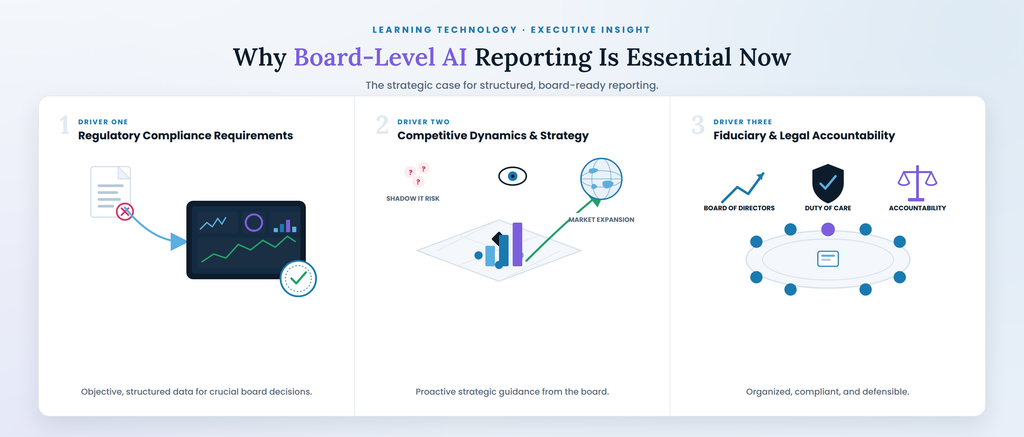
As a CLO or CIO, bridging this gap is your responsibility. The board requires objective, structured reporting for three critical reasons:
- Regulatory Compliance Requirements: OSFI supervisors do not want to see static, point-in-time PDFs. They expect proof of active, continuous monitoring of AI competencies and risk guardrails.
- Competitive Dynamics: As other companies indulge in AI initiatives to take part of the market share, it is necessary for the board to know what initiatives has the organization undertaken and their respective results for this expansionary goal. This keeps accountability intact to avoid shadow IT risks.
- Fiduciary and Legal Accountability: Boards have a legal duty of care. Board level individuals are now accountable for the decisions they make for AI level projects.
What Board Level AI Readiness Reporting should look like?
Although it might be natural to assign the big wins to “hours of training completed” or “increase in speed cycle”, the simple hours saved model often falls short from taking into account the comprehensive effects of AI readiness in the workforce.
IBM research estimates that “more than 120 million workers in the world’s 12 largest economies may need to be retrained or reskilled.” Boards are now requesting information from management on AI’s impact on the company’s employees while also asking questions about how AI could affect the company’s workforce size; recruiting; efforts around diversity, equity, and inclusion; and costs for retraining and skill development (IBM, The enterprise
guide to closing the skills gap).
To answer these questions, management can classify the operational and business impact of AI using Clickup’s 3 Bucket Value framework:
- One-to-Ten Automation (Speed): Quantifying how existing workflows are accelerated with significantly less manual effort.
- Zero-to-One Capabilities Unlocked (Strategy): Identifying entirely new, high-value capabilities that were previously impossible to execute due to resource, budget, or scale constraints.
- C-to-A Quality Boosts (Quality): Tracking the systemic reduction of errors, the elevation of work quality, and the mitigation of operational risks.
Raw Data Required for Board Level Reporting
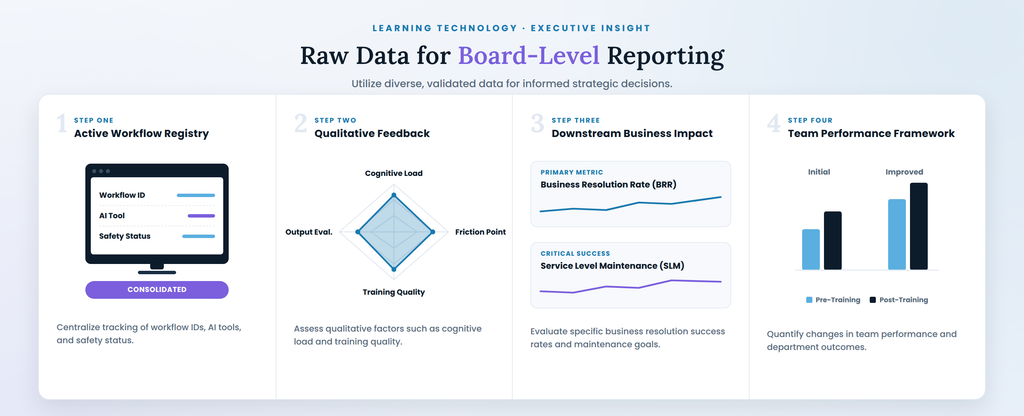
If you are starting from a place of unstructured, siloed information, you must, as a CLO/CIO, immediately delegate human resources to build a proxy baseline. This proxy baseline serves as your temporary, highly practical starting point and must span four essential operational areas:
- Active Workflow Registries: Establish a mandatory centralized tracking system where employees log active AI workflows, tools used, and safety configurations. This eliminates “shadow AI” and provides a consolidated inventory.
- Qualitative Capability and Fluency Surveys: Run quarterly surveys and targeted interviews to measure cognitive load, active AI workflow friction, and employees’ firsthand experience with AI training programs and outputs.
- Downstream Business Outcomes: Move past the “hours saved” metric. Instead, report on tangible business resolutions. For example, show how the customer support division used AI alignment to resolve an incoming surge of 150 extra tickets without requiring emergency hiring or burning out the current team.
- Team Output Framework: Structure clear before-and-after evaluations mapping qualitative team outputs and overall department productivity prior to and following your AI readiness training initiatives.
What Platform Infrastructure Is Required to Produce This Report?
To move away from manual reporting systems, your organization needs a robust, centralized talent management designed for the regulated enterprise:
Governance-Aligned Reporting
AI capability reporting should support recognized governance frameworks such as the NIST AI Risk Management Framework (AI RMF) and ISO/IEC 42001 and OSFI Guidelines. Boards members now increasingly expect workforce capability reporting alongside AI governance and risk management.
Centralized Workforce Capability Data
Disconnected spreadsheets and multiple learning systems make board reporting difficult. To make AI readiness reporting easier, it is recommended to have a centralized system that stores: employee learning records, skills assessments and competency progress.
Skills Tracking and Learning Analytics
A standard LMS “pass/fail” checkmark is insufficient. Track more than course completion by measuring: AI skills by role, capability gaps, assessment results, and department-level progress
Executive Dashboards and Reporting
Replace quarterly manual slide compilation with live, interactive executive dashboards. Your leadership should be able to instantly filter and visualize AI capability development across any team, division, or regional branch of the organization at any given second.
Secure and Audit-Ready Data
Workforce learning data should be centralized, secure, and easily accessible for internal governance and regulatory reporting. This maintenance of audit-ready records for regulated industries such as financial services helps going through audit seasons without pitfalls.
How WeCloudData Supports AI Capability Reporting
This is where WeCloudData LMS serves as your strategic partner. Designed specifically to bridge the gap between technical operations and executive governance, WeCloudData LMS is the platform that organizes, manages, and tracks enterprise-wide workforce capability data. Rather than letting critical competency data float in unreportable silos, WeCloudData LMS centralizes all learning records, automates targeted training assignment, and continuously monitors skills progression.
Enable Board-Ready AI Capability Reporting with WeCloudData
As AI becomes a strategic priority, boards are increasingly asking for evidence that workforce capability is keeping pace with technology investment. Reporting on AI initiatives is no longer just about training completion, it requires clear, credible insights into workforce readiness, capability development, and organizational progress.
WeCloudData’s LMS helps organizations move beyond fragmented learning data by providing a centralized platform for AI capability building and executive reporting. The platform enables CLOs, CIOs, and executive teams to consolidate AI learning data, monitor capability development across the organization, and generate board-ready reports that demonstrate progress, identify capability gaps, and support informed strategic decisions.
With WeCloudData’s LMS, organizations can:
- Consolidate AI learning and capability data into a single source of truth.
- Monitor workforce AI readiness across business units and functions.
- Track participation, completion, and capability development against strategic objectives.
- Generate board-ready reports that provide clear visibility into AI capability-building initiatives.
- Identify capability gaps to inform workforce planning and future investment decisions.
Effective board reporting goes beyond sharing learning metrics. It provides leadership with confidence that the organization is building the capabilities needed to execute its AI strategy. If your organization is looking to strengthen AI capability reporting and provide meaningful insights to executive leadership and the board, schedule a consultation with the WeCloudData team to explore how WeCloudData’s LMS can support your reporting and workforce development goals.
Frequently Asked Questions
Showing hours completed only proves employees spent time on a platform, not that they can use AI safely. Regulators like OSFI expect proof of active risk-mitigation capabilities, such as an employee’s ability to identify AI hallucinations or protect proprietary data. Boards need to see verified, role-specific competencies rather than passive course completion rates.
A proxy baseline is a practical, temporary starting point created by tracking the tangible operational metrics you can measure right now. You build it by keeping a central registry of active AI tools, running targeted qualitative fluency surveys, and measuring real business outcomes. This gives you immediate, structured data to present while transitioning to a fully automated system.
You align your team’s training data directly with official compliance pillars, such as OSFI Guideline E-23 or the NIST AI RMF. Instead of presenting general IT metrics, your reports should show the exact count of certified model validators and risk officers. This proves to regulators that your staff has the precise, role-specific skills required to monitor data drift and system bias.
WeCloudData LMS consolidates your disconnected learning logs, practical skill assessments, and department spreadsheets into a single database. The platform automatically organizes this fragmented information into a clean, unified system of record for the entire enterprise. This eliminates manual data-chasing and gives you structured, reportable compliance metrics instantly.
Yes, WeCloudData LMS generates real-time executive dashboards that visually map your workforce’s upskilling progress and compliance metrics. Because the data updates automatically, you can present live readiness reports to the board at any time. This ensures your records remain secure, untamperable, and instantly ready for any regulatory audit.
Works Cited
Baig, Aamer, et al. “The AI Reckoning: How Boards Can Evolve.” McKinsey & Company, Dec. 2025, https://www.mckinsey.com/capabilities/mckinsey-technology/our-insights/the-ai-reckoning-how-boards-can-evolve.
Blakes. “OSFI Releases Final Guideline E-23 for Model Risk Management and AI Use by Federally Regulated Financial Institutions.” Blakes, 26 Sept. 2025, https://www.blakes.com/insights/osfi-releases-final-guideline-e-23-for-model-risk-management-and-ai-use-by-frfis/.
CFO Connect. “AI ROI in Finance: Why CFOs Are Measuring It Wrong and How to Fix the Scorecard.” CFO Connect, https://www.cfoconnect.eu/resources/finance-insights/finance-ai-roi-scorecard-for-cfos/. Accessed 26 Oct. 2026.
Kamau, Montel. “The Proven Power of AI in Finance: A CFO Revolution.” Serrari Group, 13 Apr. 2026, https://serrarigroup.com/the-proven-power-of-ai-in-finance-a-cfo-revolution/.
Rabideau, Rick. “Building Organizational AI Capability Through Voice, Audit, Transparency, and Trust.” Medium, 1 Feb. 2026, https://medium.com/the-ai-learning-journey/building-organizational-ai-capability-through-voice-audit-transparency-and-trust-1219b56ae2ef.
National Association of Corporate Directors, and Data & Trust Alliance Staff. “AI and Board Governance.” NACD, 15 Sept. 2023, https://www.nacdonline.org/all-governance/governance-resources/governance-research/director-faqs-and-essentials/ai-and-board-governance/.
Office of the Superintendent of Financial Institutions Canada. Guideline E-23: Model Risk Management (2027). 11 Sept. 2025, https://www.osfi-bsif.gc.ca/en/guidance/guidance-library/guideline-e-23-model-risk-management-2027.
Samta.ai. “How to Measure AI Adoption Success: 10 KPIs That Matter.” Samta.ai, 3 Mar. 2026, https://samta.ai/blogs/how-to-measure-ai.
“Board-Level AI Reporting: What Directors Need to See to Govern AI Effectively.” Business Plus AI, https://www.businessplusai.com/blog/board-level-ai-reporting-what-directors-need-to-see-to-govern-ai-effectively. Accessed 26 Oct. 2026.
“Developing an Artificial Intelligence Capability: A Theoretical Framework for Business Value.” ResearchGate, https://www.researchgate.net/publication/334289463_Developing_an_Artificial_Intelligence_Capability_A_Theoretical_Framework_for_Business_Value. Accessed 26 Oct. 2026.
“AI Board Reporting Framework.” Aikaara, https://aikaara.com/blog/ai-board-reporting-framework. Accessed 26 Oct. 2026.
“Finance AI ROI Scorecard for CFOs.” CFO Connect, https://www.cfoconnect.eu/resources/finance-insights/finance-ai-roi-scorecard-for-cfos/. Accessed 26 Oct. 2026.
IBM. [Report title to be verified]. https://www.ibm.com/downloads/cas/EPYMNBJA. Accessed 26 Oct. 2026.
