Moving an AI system from a prototype to a live product is rarely smooth. A data scientist can build a model inside a Jupyter notebook that boasts 95% accuracy, but getting that code to run reliably in a live production environment is a whole different ballgame.
Once real users start interacting with a model, a barrage of engineering questions hits all at once. Teams must determine how to deploy the model for fast predictions, track dataset versions, handle shifts in user behavior, retrain without breaking downstream services, scale infrastructure under peak traffic, and automate the entire workflow to avoid running manual scripts at 2:00 AM.
This is where MLOps enters the picture.
What Is MLOps?
MLOps, short for Machine Learning Operations, isn’t just a single software tool or a cool new job title. It’s a set of practices, culture, and architecture designed to build, deploy, monitor, and maintain machine learning systems in production—consistently and reliably.
At its core, MLOps bridges the gap between teams that usually speak very different languages:
MLOps=MachineLearning+SoftwareEngineering+DevOps+DataEngineering+Infrastructure
By combining these disciplines, MLOps ensures ML projects don’t remain forever trapped in the experimental phase, but instead operate as maintainable software products.
Why Do Organizations Need MLOps?
In standard software development, code is deterministic. If you write a piece of logic and test it, it generally produces the exact same output every single time until someone edits the code. Machine learning doesn’t work that way.
Models Are Not Static
Models don’t live in a vacuum. A model’s performance naturally degrades over time simply because the world around it changes.
Data Drift Is Real
Real-world data is messy. Upstream API updates, missing feature values, seasonal changes, or subtle shifts in consumer habits (data drift) can quietly sabotage a model’s accuracy without raising a single code error.
Deployment Is Messy
Taking a trained model file out of a sandbox and embedding it into an enterprise application requires serious backend engineering—handling REST APIs, authentication, low-latency scoring, and infrastructure limits.
Silent Failures Require Continuous Monitoring
When traditional code breaks, it usually throws a 500 Error or crashes the server. When an ML model “breaks,” it keeps running smoothly—it just starts giving terrible predictions. Without dedicated monitoring, you won’t know there’s an issue until customers start complaining.
You Need a Paper Trail
When something goes wrong in production six months down the line, organizations need a reliable paper trail to verify which data snapshot trained the model, which hyperparameters were used, and who authorized the live deployment.
The MLOps Lifecycle
Instead of treating model delivery as a linear, one-and-done project, MLOps treats it as a continuous loop.
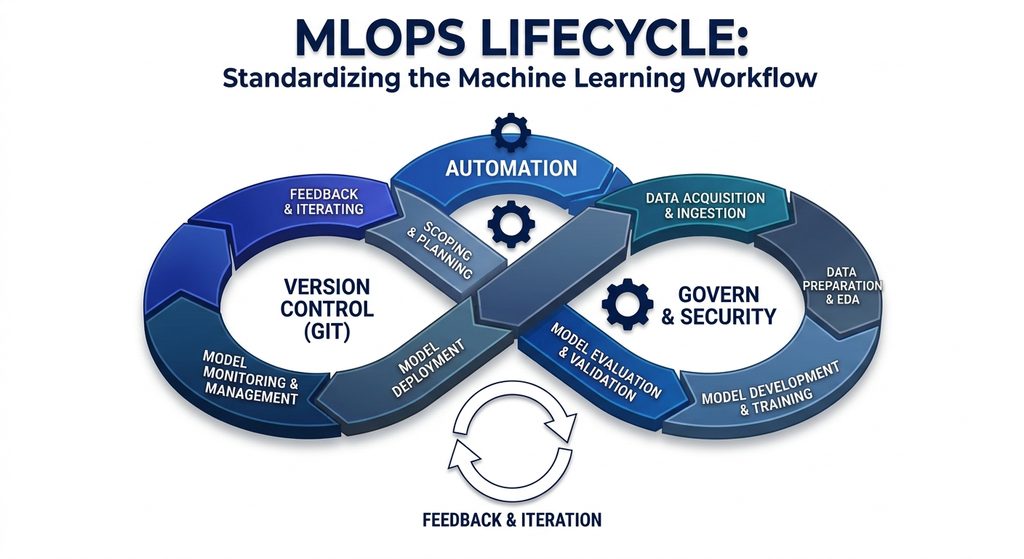
1. Data Collection and Preparation
Raw data gets pulled from lakes or databases, cleaned, transformed, and validated. Engineers build features—the specific inputs a model needs—and format them so they look identical during both training and live inference.
2. Model Development
Data scientists experiment with algorithms, run hyperparameter tuning, and test different architectures. Experiment tracking tools log every run so teams can compare results objectively.
3. Model Evaluation
Before any candidate model gets close to production, it goes through a gauntlet of tests covering statistical accuracy (precision, recall, ROC-AUC), projected business impact, system latency, and resilience against messy edge-case data.
4. Model Deployment
Once approved, the model is exposed to end users through batch inference for scheduled bulk predictions, real-time REST/gRPC APIs for instant scoring, or edge deployments on local hardware.
5. Monitoring
After going live, automated monitoring tracks system health, input data quality, and drift metrics around the clock to ensure model outputs remain reliable.
6. Retraining and Continuous Improvement
When monitoring flags performance decay or significant data drift, the system triggers a feedback loop: Monitor, Detect Drift, Retrain, Validate and Deploy. This turns model maintenance from a fire-fighting drill into an automated, continuous process.
What Does an MLOps Pipeline Look Like?
An end-to-end MLOps pipeline automates how data and code flow from raw databases all the way to production predictions.
Raw data flows through automated pipelines into a central feature store that serves uniform features to both training jobs and live APIs. Training runs automatically log metrics to an experiment tracker before pushing approved artifacts to a versioned model registry. From there, CI/CD pipelines run automated tests, containerize the application, deploy it to live servers, and monitor telemetry to trigger retraining whenever drift occurs.
MLOps vs DevOps: What’s the Difference?
While MLOps borrows heavily from traditional DevOps principles, machine learning adds a whole new dimension of complexity: data.
| Dimension | DevOps | MLOps |
| Main Target | Traditional software applications | Machine learning systems |
| Core Artifact | Code binaries and compiled assets | Code + Data + Trained model weights |
| Testing Scope | Unit, integration, and UI testing | Code tests + Data validation + Model performance checks |
| Deployment | Deploying software code services | Deploying software code + Dynamic model weights |
| Monitoring | Server load, latency, error rates | Application health + Data drift + Concept drift |
| Versioning | Tracking code changes (Git) | Tracking code (Git), Data (DVC), and Models (MLflow) |
In short: DevOps keeps software code running smoothly, while MLOps keeps code, data, and statistical models working in harmony.
Key Components of an MLOps Architecture
Building a battle-tested MLOps stack requires a few core architectural components: automated data ingestion pipelines, centralized experiment tracking, version-controlled model registries, CI/CD engines tailored for data validation, containerization via Docker, low-latency serving infrastructure, and continuous observability stacks.
Common MLOps Tools and Technologies
Instead of buying a single all-in-one platform, most engineering teams assemble an MLOps stack out of specialized modular tools:
| Category | Typical Tools |
| Version Control | Git, DVC |
| Containers & Packaging | Docker, Podman |
| Experiment Tracking | MLflow, Weights & Biases, Neptune |
| Compute & Orchestration | Kubernetes, Ray, Spark |
| CI/CD | GitHub Actions, GitLab CI, Jenkins |
| Workflow Scheduling | Apache Airflow, Prefect, Kubeflow |
| Cloud Platforms | AWS SageMaker, Azure ML, GCP Vertex AI |
| Monitoring & Drift | Prometheus, Grafana, Evidently AI, Arize |
(Note: There is no single mandatory toolchain here—your stack depends entirely on your current tech ecosystem, budget, and regulatory constraints.)
What Skills Do You Need for MLOps?
Because MLOps sits at a major technical intersection, it demands a blend of cross-functional capability spanning Machine Learning (algorithms and evaluation), Software Engineering (Python and API design), DevOps (CI/CD and containerization), Cloud Infrastructure (networking and compute), and Data Engineering (ETL and feature stores).
You don’t necessarily need every team member to be a master of all five domains. Instead, the goal is building cross-functional collaboration so data science and platform engineering speak the same language.
A Practical Example: Deploying a Churn Prediction Model
To see how this works in practice, let’s look at a common enterprise scenario: predicting customer churn for a telecom company.
The Old Way (Without MLOps)
A data scientist pulls a manual CSV export, cleans it locally, and trains a churn model on their laptop. They save the model file as a pkl artifact and email it to the engineering team, who write custom wrapper code to host it on a web server. Six months later, churn numbers spike unexpectedly because customer habits changed, but nobody knows which dataset built the original model or how to fix it.
The MLOps Way
Customer behavior data streams continuously into a cloud data warehouse through validated pipelines. Training runs log performance automatically to a model registry, while CI/CD pipelines run integration tests and launch canary deployments on Kubernetes. Live observability tools continuously stream drift metrics, triggering an Airflow pipeline to retrain, validate, and update the model seamlessly without downtime the moment performance drops.
Common MLOps Challenges
Transitioning to MLOps isn’t always smooth sailing. Teams routinely run into hurdles like poor data quality, lack of experiment reproducibility, manual team handoffs, silent model drift post-launch, unintegrated tool sprawl, and cross-functional skill gaps.
How Organizations Build MLOps Capability Step-by-Step
Organizations don’t need to build a fully automated system overnight. MLOps maturity happens in progressive stages:
- Pick One High-Value Project: Start with a single, clear production use case to test your workflows.
- Standardize Version Control: Ensure code, parameters, and datasets are tracked consistently across the team.
- Automate Data Pipelines: Move away from manual CSV exports and build scheduled, validated data pipelines.
- Adopt Experiment Tracking: Use a central registry so experiments and model artifacts are cataloged cleanly.
- Automate Deployment (CI/CD): Introduce container builds and automated integration tests for deployments.
- Set Up Basic Monitoring: Start tracking basic operational metrics and prediction sanity checks in real time.
- Close the Retraining Loop: Connect monitoring alerts directly back to automated retraining pipelines.
Building Production-Ready AI Capabilities With WeCloudData
MLOps is one part of a much broader technology capability stack. Building and operating modern AI systems requires expertise across data, AI engineering, cloud, MLOps, DevOps, and the people who bring these capabilities together.
At WeCloudData, we support both individuals and organizations in building these capabilities. Our learning programs span Data Analytics, Data Engineering, Data Science, AI Engineering, Cloud Engineering, MLOps Engineering, and DevOps Engineering, while our corporate training programs help organizations develop practical technology skills aligned with their business and workforce needs.
Whether you are an individual developing the skills to work with modern data and AI technologies or an organization building the technical capabilities needed to implement them at scale, WeCloudData focuses on turning knowledge into practical, job-ready and production-ready capability.
Frequently Asked Questions
1. What is MLOps?
MLOps (Machine Learning Operations) is a set of engineering practices, tools, and processes used to automate, deploy, monitor, and maintain machine learning models reliably in production environments.
2. What tools are used in MLOps?
Popular MLOps tools include Docker (containers), Kubernetes (orchestration), MLflow (tracking/registries), Apache Airflow (pipeline orchestration), GitHub Actions (CI/CD), and cloud platforms like AWS SageMaker, GCP Vertex AI, or Azure ML.
3. What skills are needed for MLOps?
MLOps requires a mix of Machine Learning, Software Engineering (Python, APIs), DevOps (CI/CD, Docker), Cloud Infrastructure, and Data Engineering skills.
4. What is the difference between MLOps and LLMOps?
MLOps focuses primarily on traditional predictive machine learning models (like classification or regression). LLMOps adapts those same lifecycle principles for Large Language Models and generative AI, focusing on prompt management, vector retrieval, RAG evaluation, and fine-tuning.
