
Key Takeaways
- Spreadsheets may appear attractive to use given zero cost but it has multiple hidden costs
- Hidden Costs of manual compliance includes: administrative time waste, inability to work due to expired licenses, low visibility of errors, heavy penalties in case of compliance missed and more
- As compliance becomes difficult to track with growing organizations (>200), these companies are shifting toward an LMS with automated compliance tracking to organize and structure their work
- WeCloudData’s LMS helps automate compliance management, helps manage and track employee training compliance automatically, maintain audit-ready records, and provide real-time visibility without relying on manual spreadsheet maintenance.
Time to rethink your current manual compliance system?
Almost every organization has used a spreadsheet to track their compliance training at some point. It starts with an alluring vision of a practical solution. A simple spreadsheet document that can be used to store the employee’s name, certification dates, expiry dates and renewal deadlines. After all, the spreadsheet is free. But the problem is not based on its free availability but the cost of managing the work.
But for a growing technology company scaling between 200 and 2,000 employees, that tracker silently evolves from a convenient tool into a high-risk operational vulnerability. It is essential to understand that the spreadsheets were meant to help with storing and doing calculations but not designed to become compliance systems.
This article explores the hidden operational risks of managing manual compliance training in spreadsheets, why those risks increase as technology companies grow, and how a modern LMS helps automate compliance tracking while keeping training records audit-ready.
Where Manual Compliance Systems Breakdown
For an L&D Director or Operations leader at a fast-growing software company, the primary threat of spreadsheet-based tracking is not the immediate line-item cost of the software license. It is the invisible margin of error and the catastrophic visibility gaps it creates. If you are looking for a definitive number, the exact financial impact varies by organization, manual compliance management increases administrative workload, creates unnecessary audit preparation time, and raises the likelihood of costly compliance gaps.
To truly see where this costs stem out, manual compliance costs can be categorized into:
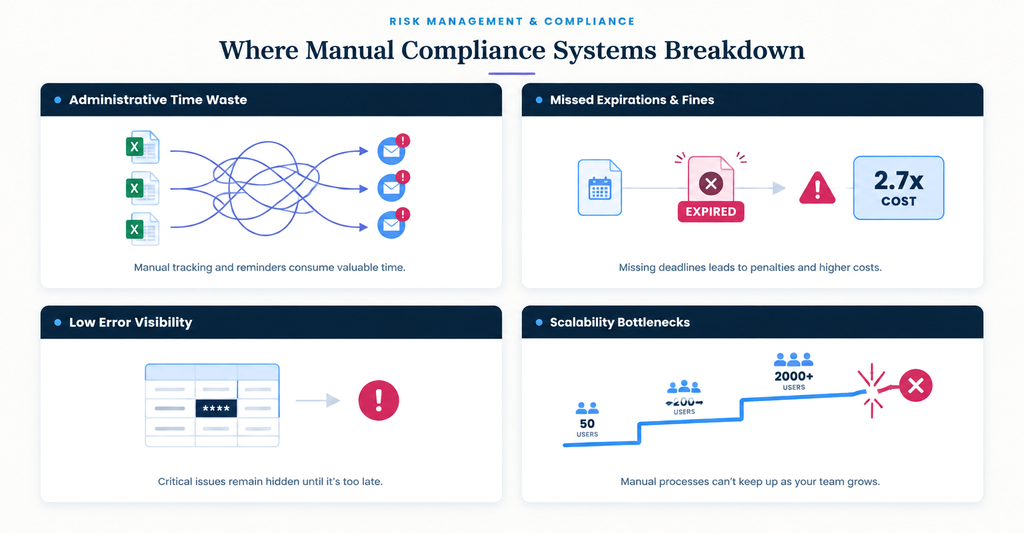
Administrative Time Waste
Time spent by staff to manage the system which can chip away valuable time into sending follow up, sending reminders and chasing people to renew their licenses. As the workforce grows, these tasks become increasingly difficult to handle. Instead of opting for a LMS with automated compilance system, valuable time is spent on maintaining and monitoring information that can be automated.
Compliance Violations and Fines due to Negligence
The manual system heavily relies on the handling, tracking and flagging of certification expiration. This in turn is based on the person remembering to update the records and identifying upcoming deadlines, A single missed certification renewal can create serious consequences. Non-compliance costs are 2.65-times the cost of compliance itself, a finding that dates back to the Ponemon Institute’s landmark 2011 benchmark study. When compliance records aren’t accurate or readily available, HR and L&D teams often scramble to verify employee training before customer audits or regulatory reviews. Time that should be spent supporting the business instead goes toward manually checking spreadsheets, confirming completion records, and resolving discrepancies.
Lost Productivity from Compliance Gaps
In many industries, expired certifications can prevent employees from performing certain responsibilities until the requirements are met. For growing technology companies, compliance gaps often surface during customer due diligence, SOC 2 audits, ISO certification reviews, or internal risk assessments. Discovering expired certifications or incomplete mandatory training at that stage creates unnecessary remediation work, delays audits, and undermines confidence in compliance processes.
Low Visibility of Errors
Spreadsheets are as useful and accurate as the information entered into them. With multiple people managing the same sheet, human input errors are more than likely to occur. A wrong expiration date can create significant compliance gaps. The larger problem at hand is that there is no way to outline these errors unless it surfaces as a late emergency or causes loss to the organization.
Scalability Issue
Spreadsheet works well with a limited number of employees (e.g. 10) but if the organization grows too large (e.g. 2000), it becomes a ticking time bomb waiting to go off. With a growing number of employees e.g. 2000, and their data it becomes difficult to manage and flag as easily as it was with 10 people. As organizations grow across multiple departments, locations, or business units, spreadsheet-based processes become increasingly difficult to maintain. Hundreds of employees, multiple compliance requirements, recurring certifications, and changing job responsibilities quickly outgrow manual tracking methods.
According to a later report from Ponemon Institute and Globalscape from 2017, the costs associated with business disruption, productivity losses, lost revenue, fines, penalties, and settlement costs add up to 2.71-times the cost of compliance. This significant amount has in turn nudged organizations to invest in software solutions.
How an LMS With Automated Compliance Tracking Reduces Costs
To overcome these challenges and risks, organizations are increasingly adopting LMS platforms with automated compliance tracking. An LMS provides a structured way to manage employee training, certifications, completion status, and compliance requirements in one centralized system.
Instead of relying on individuals to remember deadlines or maintain spreadsheets, the LMS automates much of the tracking and follow-up process. Key benefits include:
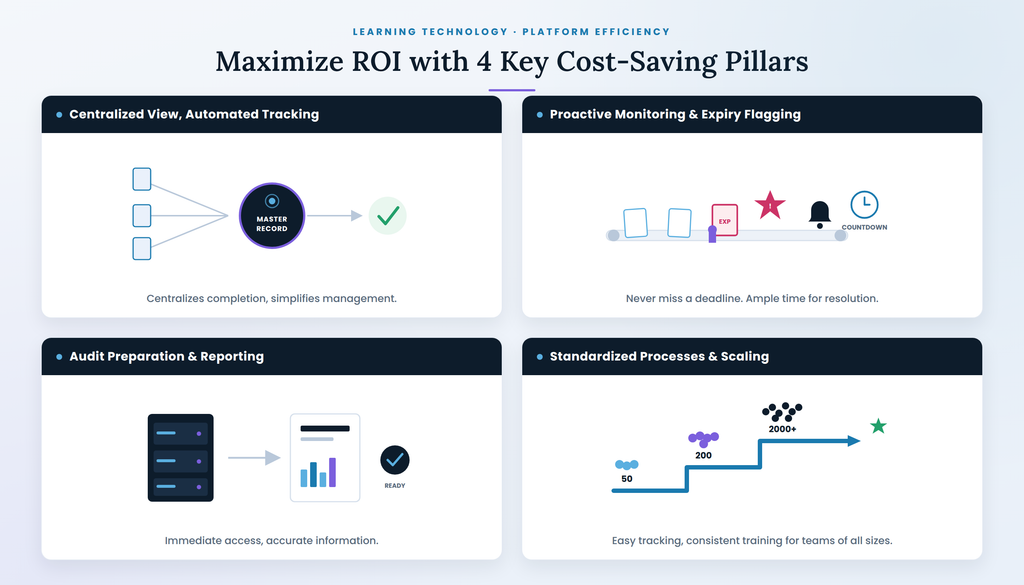
Automated Compliance Tracking
An LMS such as WeCloudData provides a centralized view of employee training and certification status. HR and training teams can quickly see who has completed required training, which departments require attention, and where follow-up is needed which in turn reduces the manual work associated with spreadsheets and disconnected records.
Automatic Flagging of Expiring Certifications
An LMS can proactively monitor certification and training validity periods. Instead of discovering expired certifications after the deadline, teams can receive automated reminders about upcoming expirations, giving them time to take action and maintain compliance.
Easier Audits With Centralized Reporting
Audit preparation becomes easier when training and compliance records are maintained in one system. Rather than collecting information from multiple spreadsheets or departments, organizations can quickly access training completion, certification, and compliance reports when required.
Standardized Processes at Scale
An LMS helps standardize training and compliance processes across departments and employee groups. With structured workflows and centralized tracking, organizations can manage compliance for hundreds or thousands of employees more consistently than with manual processes.
By replacing manual tracking with automated workflows, centralized reporting, and real-time visibility, an LMS can reduce the operational effort required to manage compliance training. WeCloudData’s LMS combines these capabilities with enterprise learning and workforce development, giving organizations a single platform for managing training and compliance at scale.
Moving from Spreadsheet to Smart LMS Systems with WeCloudData
Spreadsheets may seem like a simple way to track employee training compliance, but as organizations grow, the limitations become difficult to ignore. Manual updates, missed renewal deadlines, scattered records, and time-consuming audit preparation create unnecessary risks that can impact productivity and compliance readiness.
The solution is not simply replacing one tracking file with another. It is about building a management process that can scale. A Learning Management System (LMS) like WeCloudData helps organizations automate compliance training management by organizing employee requirements, tracking completion progress, monitoring certification timelines, and maintaining centralized records. Instead of relying on manual spreadsheet updates, HR teams and managers gain real-time visibility into compliance status across the organization.
With WeCloudData’s customizable LMS, organizations can:
- Automatically assign role-based compliance training so employees receive the right learning without manual administration.
- Track employee training completion and compliance status in real time
- Monitor completion status in real time across departments, locations, or teams from a centralized dashboard.
- Maintain organized, audit-ready training records
- Generate reports that provide visibility into compliance performance
For growing technology companies, compliance management is no longer simply about recording completed training. It is about reducing the margin for human error while giving HR and L&D teams confidence that required training, certifications, and policy acknowledgements remain current across the workforce.
If your organization is struggling with manual compliance tracking, schedule a consultation call with the WeCloudData team to explore how a customized LMS solution can help simplify compliance management and create a more scalable system.
Frequently Asked Questions
An LMS with automated compliance tracking helps organizations assign required training, monitor completion, track certifications, and maintain records for reporting and audits. It brings these activities together in one centralized learning platform.
Spreadsheets rely on manual updates and can lead to missed deadlines, inaccurate records, and limited visibility. An LMS automates tracking, reminders, reporting, and record management in one system.
An LMS can automate training assignments, track completion, monitor certification deadlines, and provide real-time compliance reporting. This gives HR and training teams a more consistent way to manage compliance at scale.
Yes. WeCloudData LMS helps organizations manage compliance training through automated workflows, centralized tracking, real-time visibility, and audit-ready reporting without relying on spreadsheets.
Yes. WeCloudData LMS can be used to manage and track existing training content while automating assignments, monitoring completion, and maintaining centralized training and compliance records.
Works Cited
Ashe, Anthony. “Hidden Costs of Manual Compliance Tracking.” MedTrainer, 22 Oct. 2026, medtrainer.com/blog/hidden-costs-of-manual-compliance-tracking/.
Deligiorgi, Iliana. “The Hidden Costs of Spreadsheet HR (Time, Errors, Compliance Risks Explained).” TalentHR, 9 Dec. 2025, www.talenthr.io/blog/spreadsheet-hr/.
Fitzgerald, Anna. “What Is Compliance Management Software? + Why Your Organization Needs It.” Secureframe, 27 Feb. 2025, secureframe.com/blog/compliance-management-software.
“The Hidden Costs of Manual Compliance Management: True TCO Analysis.” FileFlo, Nov. 2025, www.getfileflo.com/blog/hidden-costs-manual-compliance.
“The Hidden Costs of Using Excel for Training Management (And Why It’s Time to Move On).” Training Tracker, 17 Feb. 2026, www.trainingtrackersoftware.com/blog/the-hidden-costs-of-using-excel-for-training-management-and-why-its-time-to-move-on.
“The True Cost of Manual Training Compliance in Regulated Organizations.” Meridian Knowledge Solutions, meridianks.com/true-cost-manual-training-compliance-regulated-organizations/. Accessed 23 Oct. 2026.
